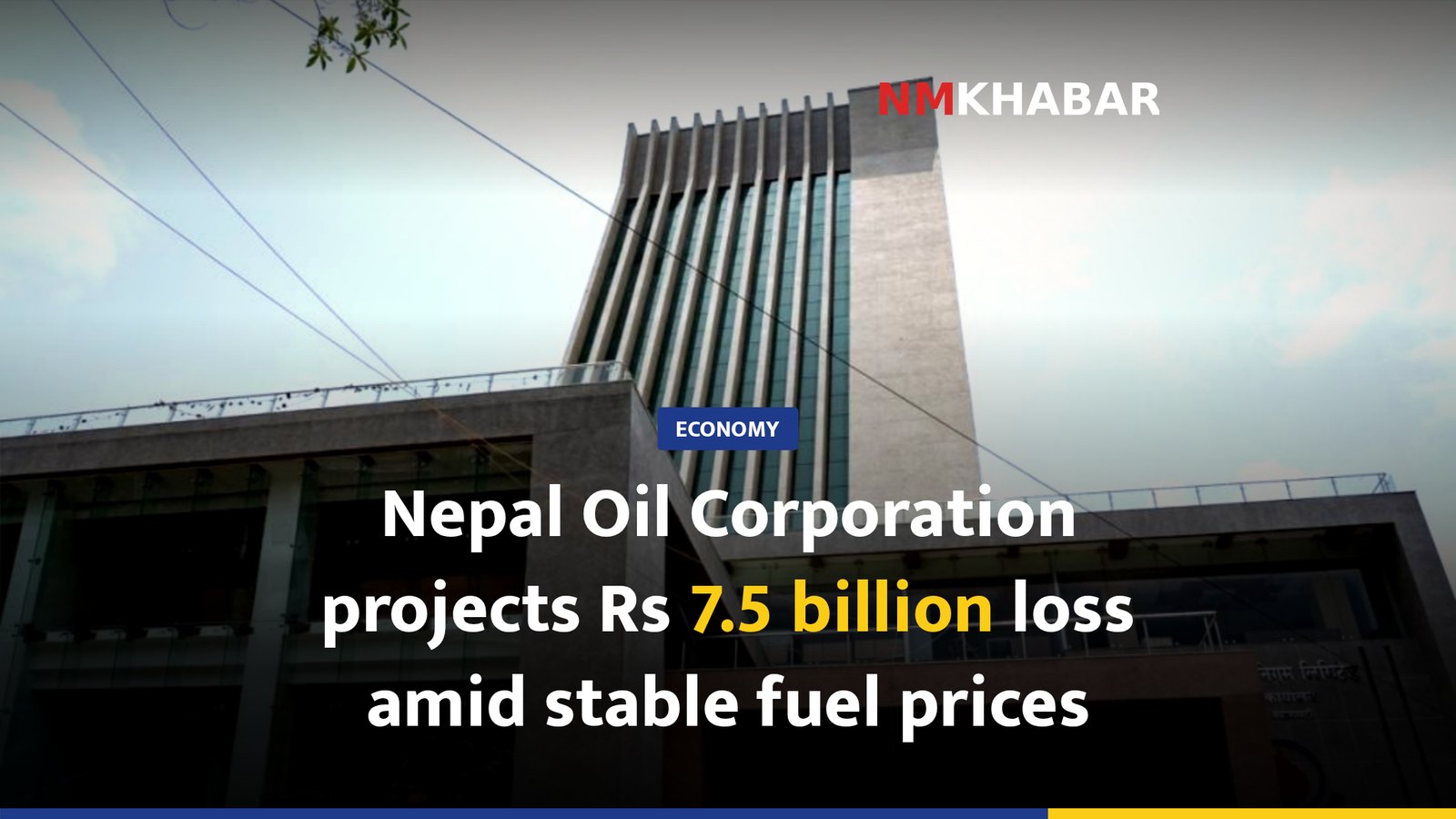
Nepal Oil Corporation (NOC), the state-owned monopoly for petroleum products, projects a net loss of approximately Rs 7.5 billion for the first three months of the current fiscal year, from mid-July to mid-October. The projected loss comes as the corporation maintains stable domestic fuel prices despite a continuous rise in international crude oil and refined fuel costs.
The financial pressure on NOC is primarily attributed to its inability to fully implement an automatic fuel pricing system in the domestic market, coupled with surging global prices. Manoj Thakur, NOC spokesperson, stated that international market prices are beyond the corporation’s control, and geopolitical developments are significantly impacting its finances.
Liquefied petroleum gas (LPG) is identified as the largest source of losses, with NOC currently incurring a loss of Rs 493 on every cylinder sold. Additionally, the corporation is losing around Rs 26.50 per litre on petrol and Rs 48.50 per litre on diesel. The government has opted to keep fuel prices stable during the festive season and in response to recent floods and landslides, aiming to provide relief to consumers.
Mounting Losses and Financial Strain
NOC began the fiscal year on a positive note, recording a profit of Rs 710 million in the first half of Shrawan. However, the financial situation quickly deteriorated. Losses increased steadily, reaching Rs 1.49 billion in the second half of Shrawan, Rs 313.5 million in the first half of Bhadra, and Rs 1.24 billion in the second half of Bhadra.
The pressure intensified in Asoj. NOC recorded a loss of Rs 1.9169 billion between September 17 and October 1. For the subsequent 15-day period, from October 2 to October 16, the corporation projects an even larger loss of Rs 3.2038 billion. Overall, NOC expects to incur losses of around Rs 8.1679 billion from the second half of Shrawan through the end of Asoj. After accounting for the initial profit, the net loss for the three-month period is projected to be approximately Rs 7.46 billion.
Managing the Crisis
Nagendra Sah, NOC Executive Director, confirmed that the corporation is currently absorbing these losses to shield consumers from immediate price increases. He attributed the recent surge in international crude oil prices to developments in Saudi Arabia. Sah stated that NOC would utilise its Price Stabilisation Fund, which currently holds Rs 4.7 billion, to manage the losses and maintain smooth supplies for “a month or two.”
Sah expressed hope that international prices would decline within the next 15 days or month. If prices do not fall, he indicated that NOC would have to approach the government to increase fuel prices. He also recalled that NOC had previously borrowed Rs 7 billion from the government by pledging land during the Russia-Ukraine war, but noted that the corporation does not face a similar immediate crisis now.
LPG Supply and Future Outlook
Despite increased imports, consumers continue to report shortages of LPG in the market. NOC data shows a significant increase in LPG imports, with 57,316 tonnes (equivalent to about 4.036 million cylinders) imported in Shrawan alone, an increase of roughly 900,000 cylinders compared to the same month last year. NOC spokesperson Manoj Thakur urged consumers not to hoard LPG, stating that supplies are being maintained.
Thakur suggested that Nepal needs to gradually reduce its dependence on imported LPG by increasing domestic electricity consumption. However, he acknowledged that the corporation currently has limited options due to consumers’ continued reliance on LPG. The long-term solution for addressing high LPG losses and growing demand remains unclear, as does how long NOC can sustain these losses and what further government measures might be taken.
The current retail prices for petrol and diesel are Rs 200 per litre in Kathmandu, Pokhara, and Dipayal; Rs 199 in Surkhet and Dang; and Rs 197.50 in major Terai cities. LPG is priced at Rs 2,060 per cylinder, and aviation fuel for domestic flights is Rs 249 per litre. The government’s decision to keep prices stable, despite the automatic pricing system, highlights the ongoing challenge of balancing consumer relief with NOC’s financial sustainability.