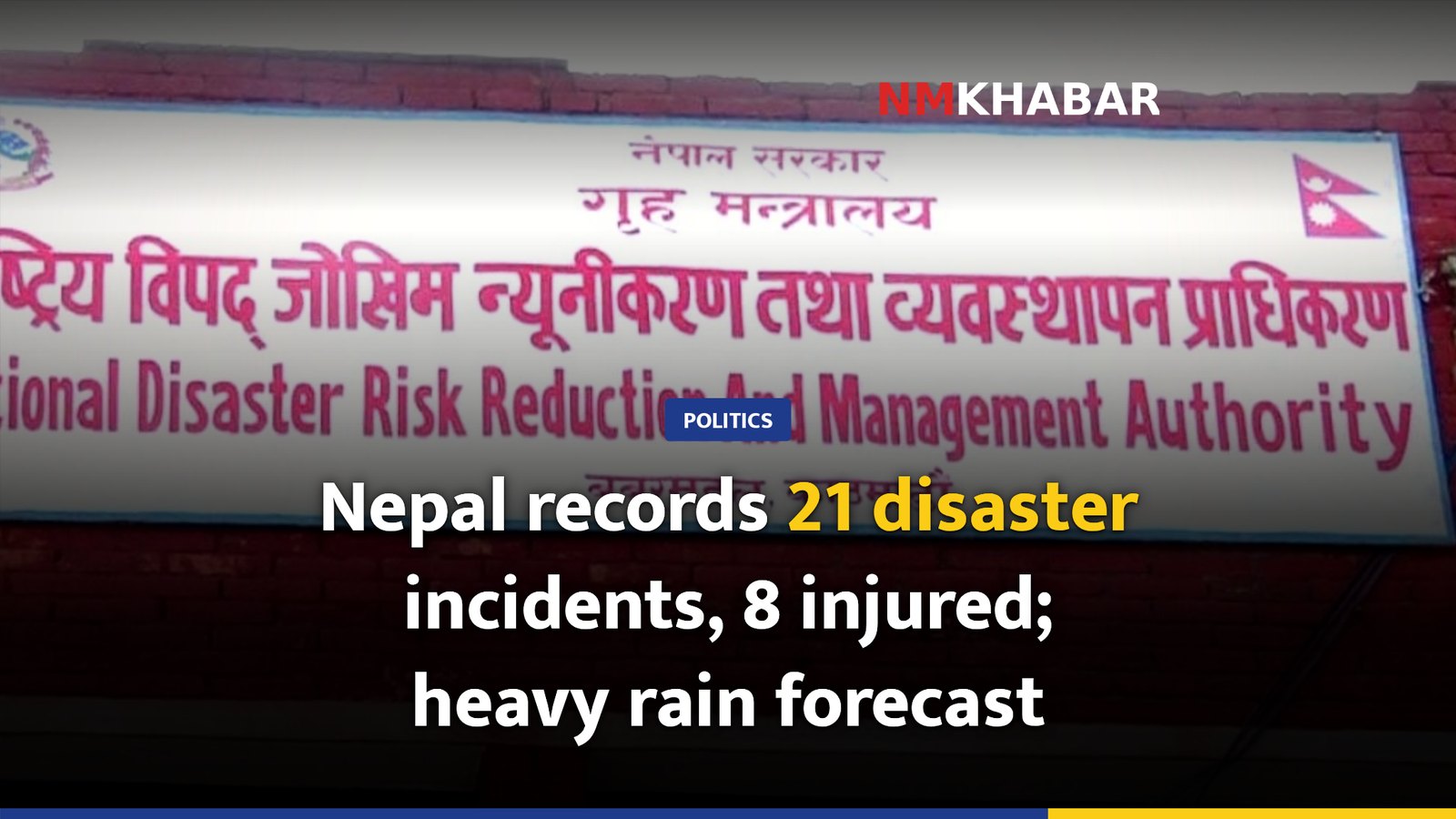
Nepal experienced 21 disaster incidents across the country in the past 24 hours, resulting in eight injuries, as the National Disaster Risk Reduction and Management Authority (NDRRMA), Nepal’s central body for natural disaster risk reduction and management, issued a warning for potential heavy rainfall in several provinces from October 3 to 6, 2026.
The incidents, which occurred from the morning of Ashoj 15 (BS) to Ashoj 16 (BS), included snakebites, landslides, floods, fires, continuous rain, and animal attacks, according to NDRRMA spokesperson Shanti Mahat. To manage the affected areas, 165 police personnel were deployed for rescue, relief, and management efforts.
Preliminary reports indicate that snakebites accounted for the highest number of incidents, with seven cases. There were also five landslides, three floods, two fires, and two animal attacks. One incident was attributed to continuous rainfall. The disasters caused damage to two livestock and an estimated economic loss of approximately Rs 12,000.
Nepal’s Vulnerability and Past Toll
Nepal is globally recognized as one of the countries most vulnerable to disasters due to its sensitive geographical structure and the rapid impacts of climate change. Each year, the monsoon season and other adverse weather conditions lead to significant loss of life and property from floods, landslides, lightning, fires, and snakebites.
To address these challenges, Nepal has adopted the Disaster Risk Reduction and Management Act, 2074 (BS), and its Regulations, 2076 (BS), as key legal frameworks. These cover the entire disaster cycle, including preparedness, response, and rehabilitation. The NDRRMA was established on Kartik 29, 2076 (BS) (November 15, 2019), as the central resource body for natural disaster risk reduction and management, playing a coordinating role in mitigating risks and enhancing response effectiveness.
Over the past decade, seasonal disasters, including floods, landslides, heavy rainfall, and lightning, have claimed 3,052 lives, left 791 people missing, and injured 4,176 others. Nepal has also affirmed its commitment to international frameworks such as the Sendai Framework (2015-2030), the Paris Agreement on climate change, and the Sustainable Development Goals (SDGs), underscoring the importance of global cooperation in disaster management.
Heavy Rain Forecast and Preparedness Measures
The Department of Hydrology and Meteorology (DHM), Nepal’s national weather forecasting agency, has projected moderate to heavy rainfall in Koshi, Madhesh, Bagmati, Gandaki, and Lumbini provinces from October 3 to 6, 2026 (Ashoj 17 to 20 BS). This forecast heightens the risk of further disaster incidents in the coming days.
In response, the NDRRMA has urged vigilance in high-risk areas and called for coordination with security agencies and local levels for rescue and management in emergencies. The Authority has instructed partner organizations, District Disaster Management Committees, and Local Disaster Management Committees involved in preparedness, pre-action, and response to remain alert. It has also requested that equipment such as bulldozers, excavators, and loaders be kept ready for immediate deployment on high-risk highways and roads. Spokesperson Shanti Mahat emphasized that continuous rainfall has saturated the ground, meaning the risk of landslides will not immediately subside even after the rain stops, requiring high vigilance for several days.
The government is also undertaking various initiatives to address the long-term impacts of disasters. There is a recognized need to amend existing laws, including the Muluki Dewani Samhita, 2074 (BS), and registration-related laws, to facilitate relief distribution and death registration for approximately 5,285 individuals missing from monsoon-related disasters, such as the Rasuwa-Bhote Koshi floods. Additionally, the government is advancing plans to relocate at-risk settlements to safer locations.
Meanwhile, Dol Prasad Aryal, the current Speaker of the Legislative Parliament, is scheduled to depart for Tanzania on Sunday, October 4, 2026, to participate in the Inter-Parliamentary Union (IPU) meeting. During the meeting, he plans to raise awareness internationally about the impact of climate change and disasters in Nepal.
For more information on how floods and landslides have previously affected Nepal’s infrastructure, see our earlier coverage: Floods, landslides disrupt Nepal’s major highways and China border points.
Unanswered Questions
- The specific locations of the 21 disaster incidents that occurred from the morning of Ashoj 15 (BS) to Ashoj 16 (BS) have not been explicitly detailed.
- Further information regarding the severity of injuries sustained by the eight individuals or the hospitals where they are receiving treatment is not available.
- Detailed descriptions of the animals involved in the two animal attack incidents and the nature of these attacks have not been provided.
- The timeline for the final verification of data for approximately 5,285 individuals missing from monsoon-related disasters, including the Rasuwa-Bhote Koshi floods, and the completion of the legal amendment process for relief distribution and death registration, remains unclear.
- Detailed plans and implementation timelines for the government’s preparation to relocate at-risk settlements are not yet available.