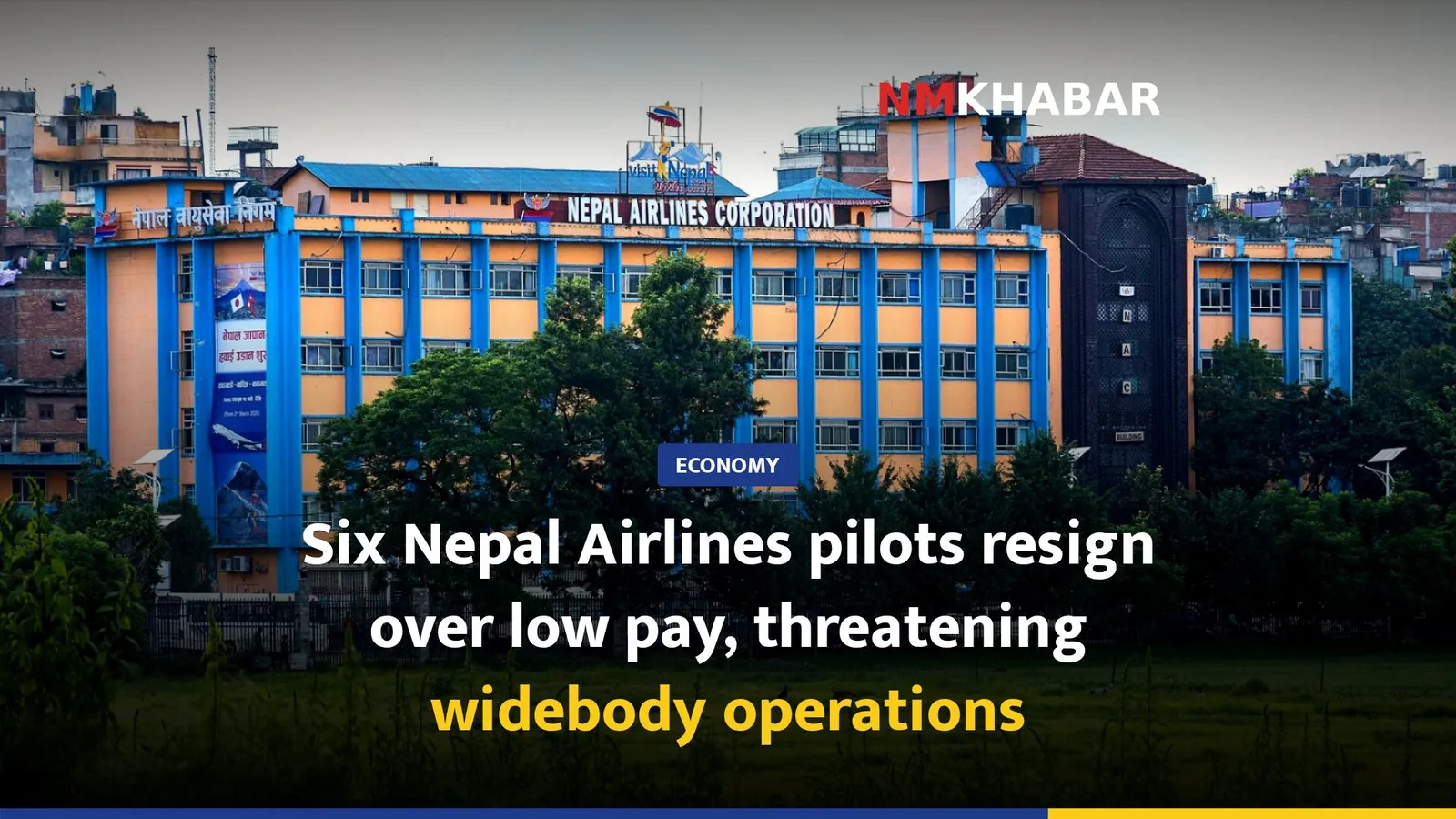
Six pilots from Nepal Airlines, the national flag carrier, have resigned citing inadequate pay and benefits, a move that threatens to disrupt the airline’s widebody operations. The departing pilots include senior widebody captains Sanjay Paudel and Prashant Shrestha, narrowbody pilot Manish Bikram Shah, and co-pilots Rachendra Joshi, Pranav Malla, and Reshma Sijapati. They are reportedly planning to join a Vietnamese airline, though the specific company remains undisclosed.
Janak Kalakheti, the acting General Manager of Nepal Airlines, confirmed that five pilots had submitted their resignations. However, he stated that the resignations have not yet been accepted, and the airline is attempting to manage the situation to prevent further operational challenges.
Pilots cite low pay, lack of career growth
The pilots’ decision stems from a combination of factors, including insufficient remuneration, a lack of regular flight hours, and the grounding of aircraft for extended periods, which hinders their professional development. Nepali pilots at the national carrier reportedly average only about 45 flight hours per month, limiting their post-tax monthly income to between Rs 250,000 and Rs 300,000. Nepal Airlines officials acknowledge that retaining skilled personnel is challenging due to foreign airlines offering significantly higher salaries and benefits.
Deepening financial woes
The resignations underscore the severe financial and operational crisis gripping Nepal Airlines. On October 2, 2026, Khadakraj Paudel, the Minister of Culture, Tourism and Civil Aviation, stated that the airline’s current economic and managerial state is “extremely fragile.” He emphasized that there is no justification for acquiring additional aircraft without first implementing structural reforms. The airline is burdened by high-interest loans, delays in fleet expansion, and a shortage of technical staff.
Nepal Airlines faces a substantial financial strain from loans taken from the Employee Provident Fund and Citizen Investment Trust, with interest rates ranging from 9.5 to 10.5 percent. This is significantly higher than the prevailing market interest rates of 4.5 to 5.5 percent. The airline’s debt burden has increased by over Rs 7 billion due to interest accrued even during the COVID-19 pandemic. Despite Nepal’s aviation market being valued at approximately Rs 120-135 billion, Nepal Airlines’ share remains limited to 15-16 percent, or about Rs 18 billion. Foreign airlines dominate Nepal’s Rs 153 billion aviation market
Legacy of challenges and corruption
Established in 1958 as Royal Nepal Airlines Corporation, Nepal Airlines has a long history of operational and financial difficulties. Since 2012, Nepal Airlines, along with all other Nepali air service providers, has been on the European Union’s list of banned airlines. The corporation has also been plagued by numerous corruption scandals over the years, including the Dhamija, Chase Air, China Southwest, Lauda Air, Airbus, and Widebody incidents.
This is not the first time pilots have collectively resigned from the national carrier. On January 24, 2020, 25 Nepali pilots submitted mass resignations, citing extreme disparities in service benefits between Nepali and foreign pilots. Earlier, on July 1, 2026, Minister Paudel described Nepal Airlines as being on “ventilator” and suggested that non-performing employees should resign.
Urgent need for government intervention
In response to the recent resignations, Nepal Airlines’ operations department has formally requested the pilots to reconsider their decision. Acting General Manager Kalakheti has highlighted the critical need for active government intervention to restructure the airline’s debt and implement corporate reforms. Minister Paudel noted that the ongoing court case regarding the appointment of a permanent General Manager creates legal hurdles, forcing the airline to operate under interim or temporary leadership. Furthermore, the airline requires approximately Rs 8 billion immediately for the maintenance of four engines. Earlier, Hit Bahadur Tamang, a former Minister of Culture, Tourism and Civil Aviation, stated that initiatives were underway for managerial, institutional, and legal reforms at the corporation, with various options being discussed for its operation in an appropriate framework.
What remains unknown
- The specific Vietnamese airline the pilots are joining has not been disclosed.
- Details regarding the salary and benefits offered by the Vietnamese airline to the resigning pilots are unavailable.
- A clear timeline for government intervention in debt and corporate restructuring has not been provided.
- The final decision date for the General Manager appointment case, currently pending in court, is unknown.