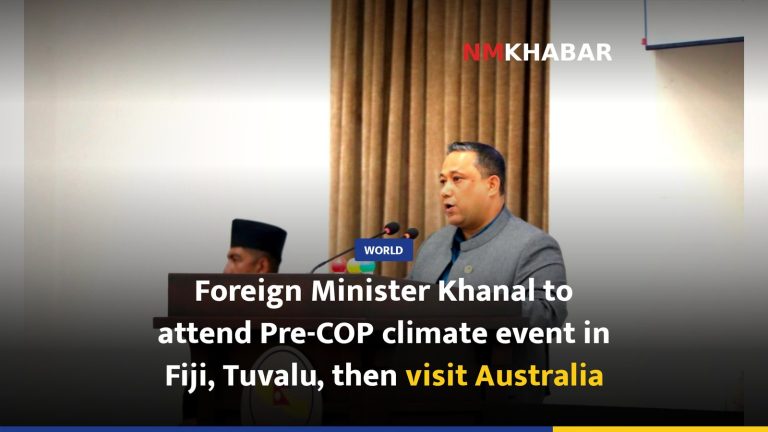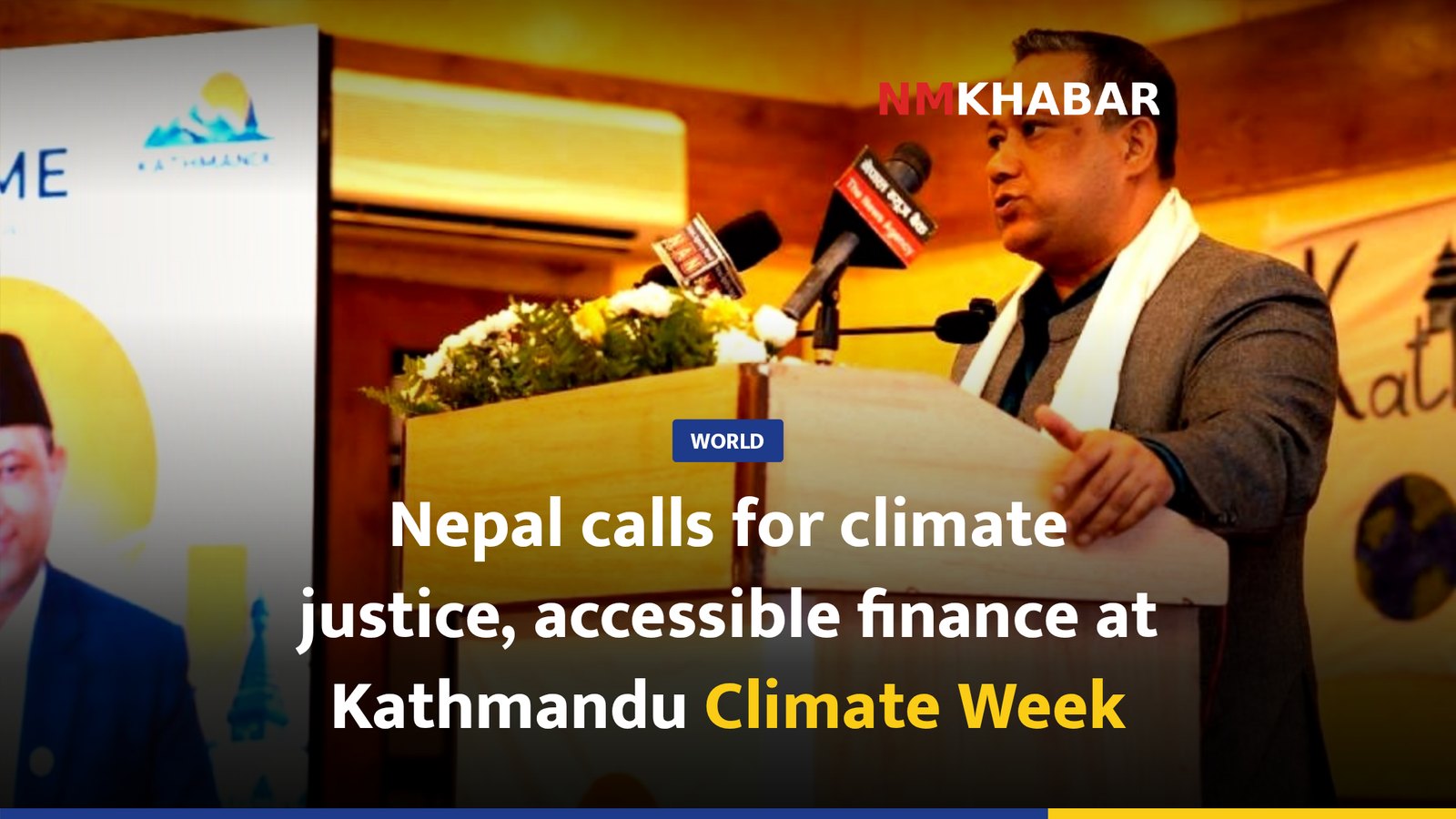
Foreign Minister Shishir Khanal today called for the practical implementation of climate justice and urged the international community to provide new, easily accessible, and grant-based climate finance to Nepal. He made the remarks at the ‘Kathmandu Climate Week-2026’, which began today.
Khanal stated that Nepal’s development, agriculture, infrastructure, water security, public health, energy transition, financial stability, and foreign policy are directly linked to climate change. Despite contributing less than 0.1% to global greenhouse gas emissions, Nepal faces a disproportionate burden, losing lives and property due to the climate crisis. Climate justice, he explained, means acknowledging this imbalance and taking concrete steps to address it.
Khanal also informed the House of Representatives, the lower house of the federal parliament, that Prime Minister Balen Shah had drawn global attention to Nepal’s climate crisis, the devastating Bhotekoshi flood, and increasing disaster risks in the Himalayan region during the General Debate of the 81st United Nations General Assembly, which concluded on September 29, 2026.
Prime Minister Shah presented the Bhotekoshi flood, which occurred on August 25, 2026, as a severe impact of the climate crisis and a warning to the world. The National Disaster Risk Reduction and Management Authority reported on September 26, 2026, that the flood killed 1,453 people, with 5,550 still missing, and over 13,000 rescued. Minister Khanal described the disaster as a “Himalayan tsunami,” which destroyed lives, critical infrastructure like roads, bridges, hydropower projects, and local livelihoods.
Climate-induced disasters create structural impediments to Nepal’s development, forcing the country to repeatedly divert limited development resources to rescue, rehabilitation, and reconstruction efforts. Khanal stressed the need to build resilient infrastructure, including roads, bridges, power transmission lines, and urban settlements, capable of withstanding climate risks for at least 20 to 30 years.
He also called for bridging the gap between scientific research and policy decisions, transforming data on glacier melt and glacial lake conditions into effective early warning systems for vulnerable communities. Furthermore, he emphasized enhancing the capacity of government institutions for effective climate finance utilization and expanding scientific cooperation with neighboring countries for transboundary climate risks, particularly for shared river systems and real-time hydrological and meteorological data exchange.
The Foreign Ministry has established a climate diplomacy unit to make Nepal’s role in international climate change negotiations more effective. This unit aims to integrate Nepal’s internal climate realities with international discussions, ensuring a coherent and proactive diplomatic approach. Khanal referred to the Himalayas as the “Third Pole,” stating that their preservation is crucial for global ecological security, as glacier-fed rivers support nearly two billion people downstream.
He also stated that Nepal’s voice in international forums, including the upcoming UN Climate Change Conference (COP-31) and the mid-term review of the Doha Work Programme, must be based on community experiences, scientific evidence, and practical solutions.
Kathmandu Climate Week-2026 is set to conclude on October 4, 2026, with the announcement of an action plan. Stakeholders have suggested developing damage assessment criteria and documentation systems for loss and damage in the draft National Climate Change Policy 2083. Foreign Minister Khanal reiterated that the credibility of international diplomacy depends on effective domestic implementation. However, the exact date of the Loss and Damage Fund’s establishment, the total amount of climate finance received by Nepal, and the detailed economic damage and compensation for the Bhotekoshi flood remain unknown.