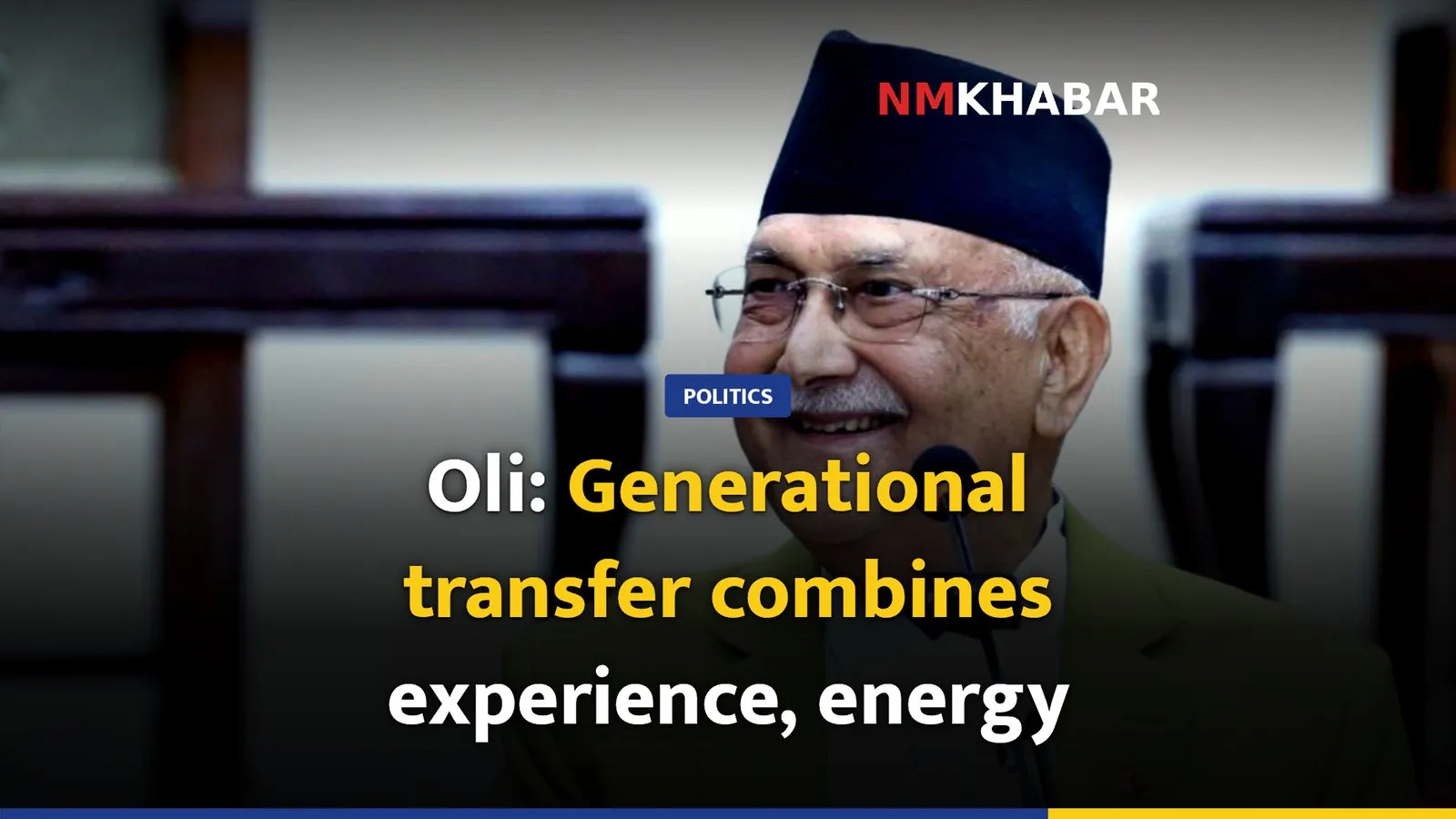
CPN-UML Chairman KP Sharma Oli stated that the party’s leadership cannot be hastily handed over in the name of generational transfer, defining it as an integration of experience and energy rather than a generational war or an emotional slogan like ‘remove the father, bring the son’. His remarks were part of a political report, ‘Antarparty Nirdeshan-3’ (Inter-Party Directive-3), issued after the party’s third central committee meeting.
In the document, Oli wrote that leadership is not developed merely by declaration but matures through struggle, decision-making during crises, the capacity to tolerate criticism, and learning from defeat. He affirmed that party leadership is not private property and that he is not in his position permanently, asserting he is there to secure the path, not block it.
Defining Leadership Transition
The report analyzes the strengths of both older and newer generations, noting that the former possesses the scars of struggle, depth of ideology, and organizational patience, while the latter embodies the pace of time, freshness of language, and technological courage. Oli warned that attempts to pit the two generations against each other could fracture the party, claiming that only a combination of three generations can strengthen it.
The CPN-UML has put forward a policy of ‘transformation, transfer, and generational transition’ to rejuvenate the party. It advocates that youth leadership should develop through assuming responsibilities, not merely through quotas. The party also accused opposing forces of attempting to weaponize the generational transfer debate to weaken the CPN-UML.
Party Reorganisation and Appointments
The central committee meeting unanimously approved the political report presented by Oli and passed 22 contemporary resolutions. Among these decisions, former President Bidya Devi Bhandari has been designated as a senior leader of the CPN-UML, holding the second position in the party hierarchy, and will participate in important organizational body meetings.
The meeting also nominated seven members to the permanent committee, including Ishwor Pokharel, Pradeep Gyawali, and former Speaker Devraj Ghimire. Additionally, 20 individuals were appointed as central members. The CPN-UML expressed strong dissatisfaction with the working style of the current government, led by Prime Minister Balen Shah, in its 22 resolutions.
Challenges and Future Outlook
The debate over generational transfer has been a long-standing issue in Nepali politics, with younger generations demanding leadership change, particularly within older political parties dominated by veteran leaders. Within the CPN-UML, central and district leaders have reportedly issued ‘ultimatums’ for Oli to relinquish leadership. The party’s earlier decision to suspend the 70-year age limit for executive roles has been criticized for complicating the generational transfer process.
A party reorganisation task force report highlighted the weakening of collective leadership and the centralization of power in the main leadership. It called for the implementation of a ‘one person, one post’ concept for equitable distribution of opportunities. Central committee member Rachana Khadka noted that events like the Gen-Z movement in Bhadra 2082 (BS) also signaled the need for leadership change within the CPN-UML.
The newly appointed central committee members are scheduled to take their oath of office from CPN-UML Chairman KP Sharma Oli today, Tuesday, October 6, 2026. The challenge remains how the CPN-UML will manage the generational transfer debate without it becoming a cause for division, and how effectively the questions raised in the party reorganisation report will be implemented, which depends on future party decisions and the political will of the leadership.