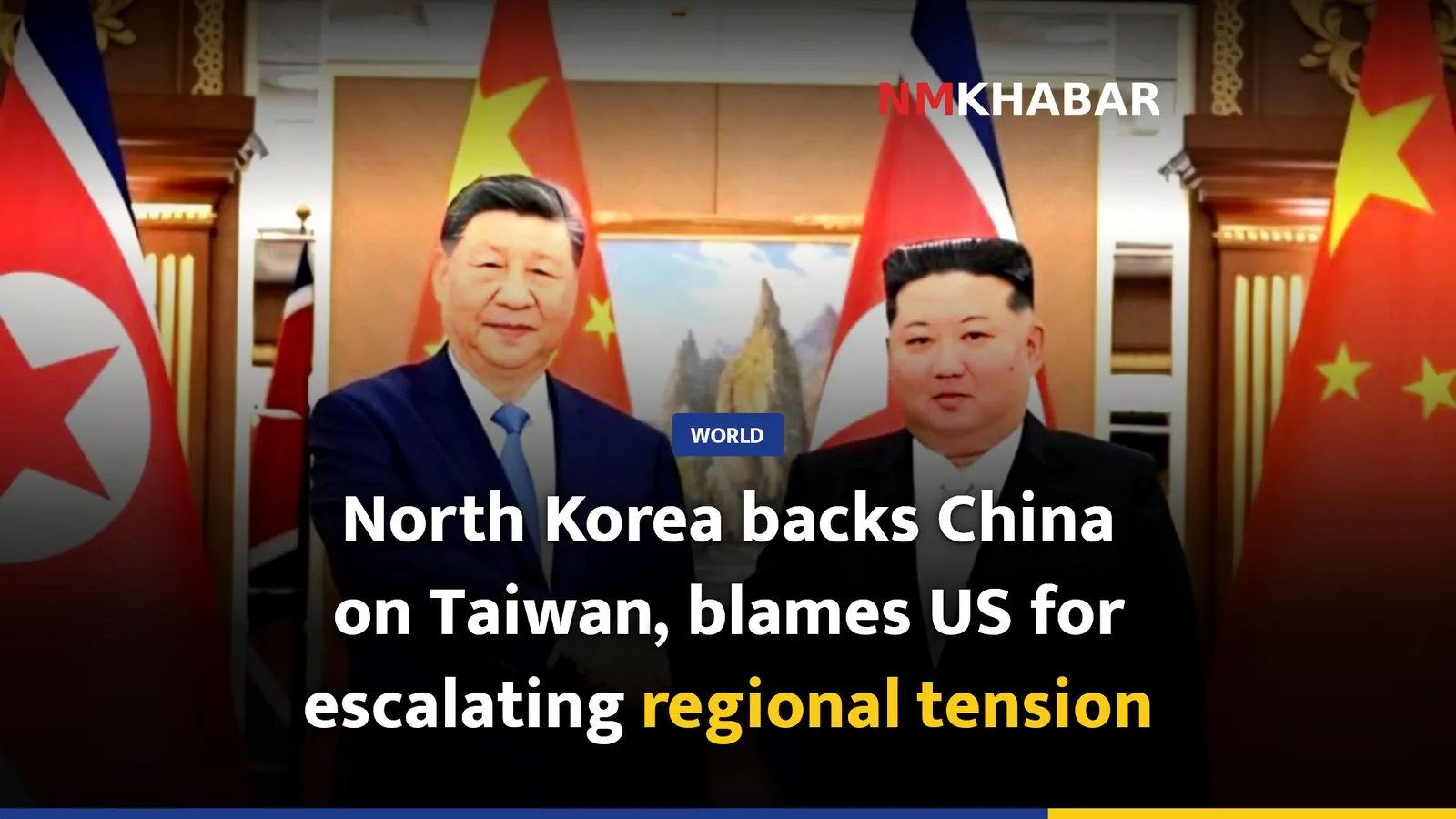
North Korea on Wednesday, October 7, 2026, defended Beijing’s ‘One China’ policy while accusing the United States of supporting Taiwan independence and escalating tension in the region.
The criticism came in an article titled “U.S. Is Acting Rashly” by international affairs analyst Kim Myong-chol, carried by the Korean Central News Agency (KCNA). Kim wrote that the US has “systematically destroyed regional stability and persistently escalated the situation under the pretext of ‘opposing unilateral attempt at change of phenomenon’ in the Taiwan Strait.”
Referring to the recent delivery of the first two new F-16V fighter jets purchased from the US to Taiwan, Kim stated, “This is nothing but a shameless act of planting a bomb at the gate of other’s house and asserting that the bomb is for ensuring the security of the house.” He claimed that munitions supplied by the US to Taiwan through overseas arms sales over the past decade alone amounted to more than $39 billion.
Kim reiterated that “The Taiwan issue is an internal affair of China, so how to settle it is entirely the affair of the Chinese people, and no outside forces have the right to interfere in it.” He warned Washington to “think twice whether it is ready to stand in frontal confrontation with the powerful national power of the People’s Republic of China for the security of Taiwan and whether it can cope with its consequences.” He concluded that “The instability of the Taiwan Strait precisely means the crisis of the United States. Taiwan’s return to China is a matter of time.”
Background on ‘One China’ Policy and Regional Ties
The ‘One China’ policy originated from the end of the Chinese Civil War in 1949, when the Communist Party (PRC) gained control of mainland China and the Nationalist Party (ROC) retreated to Taiwan. Both claimed to be the legitimate government of all China. The United Nations gave Taiwan’s seat to China in 1971, and the US recognized the People’s Republic of China in 1979.
North Korea and China have maintained long-standing economic and security ties since the Korean War. Despite tensions over North Korea’s nuclear weapons ambitions, China continues to support North Korea to maintain stability on the Korean Peninsula and prevent refugee flows.
Relations between North Korea and China have strengthened in recent years, marked by two summits: one in Beijing in September 2025 and another in Pyongyang in June 2026. During the latter summit, the two sides vowed to elevate their relationship to a “strategic partnership.” Chinese President Xi Jinping assured North Korean leader Kim Jong Un of China’s “unwavering” support during his June 2026 visit.
US Arms Sales to Taiwan Continue
The US has continued its arms sales to Taiwan, a point of contention for Beijing. Taiwan received the first two new F-16V fighter jets purchased from the US on Friday, October 2, 2026. This delivery is part of an approximately $8 billion deal for 66 F-16V aircraft agreed upon in 2019. Additionally, the US has approved a proposal to sell Taiwan $2 billion worth of advanced air defense missiles and approved the sale of $100 million in equipment and services for the maintenance and improvement of Taiwan’s Patriot missile defense system.
China has repeatedly warned against US arms sales to Taiwan and threatened sanctions against American companies involved in such transactions. Tensions and diplomatic exchanges in the Taiwan Strait are expected to continue. For related coverage, see North Korea warns US over Taiwan, Kim pledges continued support for Russia.
Nepal’s Stance on ‘One China’ Policy
Nepal has consistently expressed its firm commitment to the ‘One China’ policy, recognizing the People’s Republic of China as the sole legitimate government of all China and considering Taiwan an inseparable part of China. Nepal opposes Taiwan’s independence and has pledged not to allow its territory to be used for any separatist activities against China.
Unanswered Questions Remain
The detailed specifics of the “strategic partnership” between North Korea and China remain unclear. Furthermore, the precise impact of the recent US fighter jet delivery on the military balance in the Taiwan Strait is not yet fully known. The nature and extent of the “separatist activities” that Nepal has pledged to prevent on its soil against China also lack further clarification.