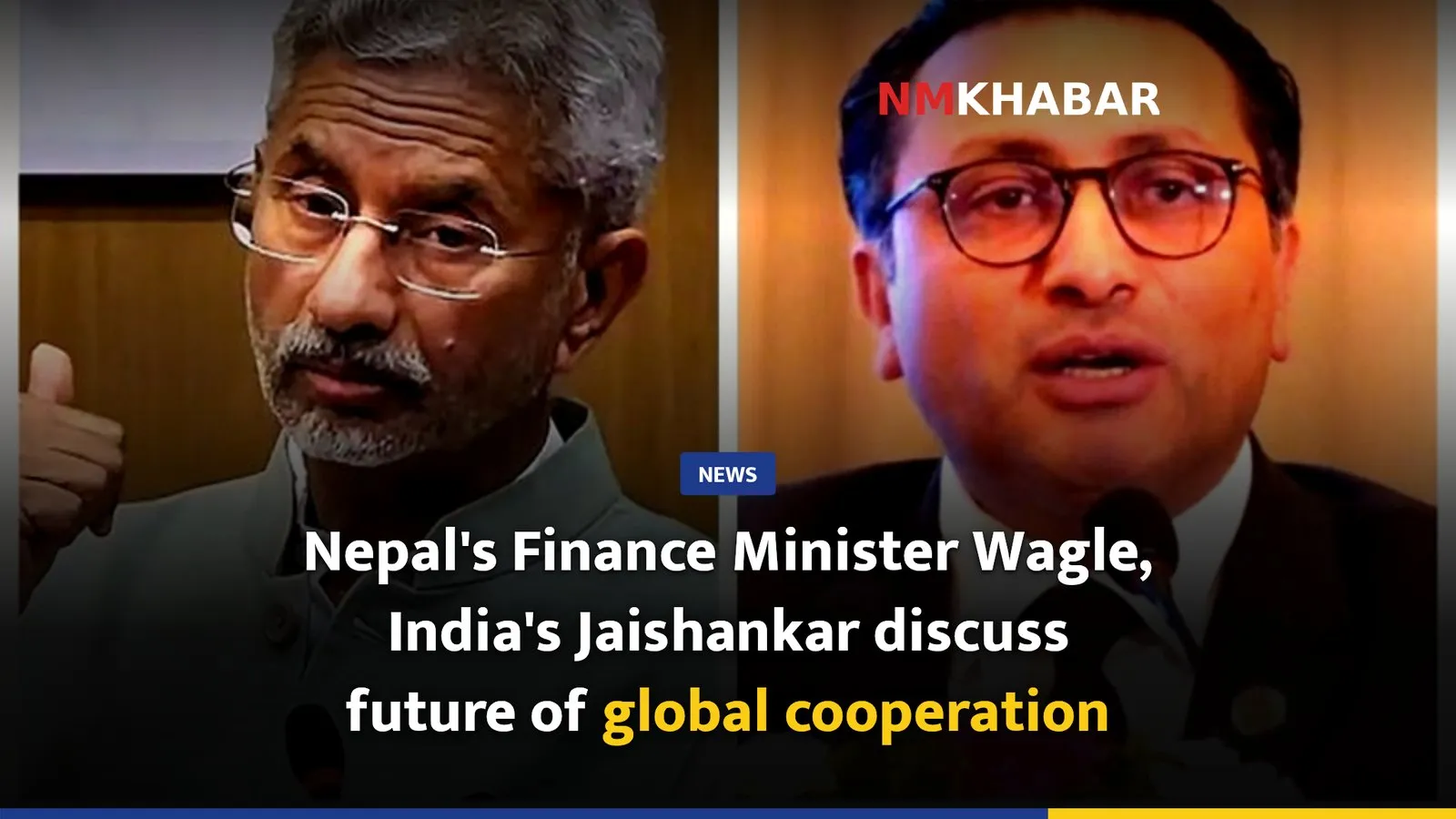
Nepal’s Finance Minister Dr. Swarnim Wagle and India’s External Affairs Minister Dr. S. Jaishankar discussed the future of international cooperation at the NDTV World Summit 2026 in New Delhi on Thursday, October 22, 2026.
The two ministers participated in a session titled ‘The Geopolitics of Sovereign Choice’ at the summit, organised by Indian television channel NDTV. Their exchange focused on shifts in the global order, the future of multilateral cooperation, and the necessity of regional and sub-regional partnerships.
Wagle’s concerns on multilateralism
Dr. Wagle recalled that after the Cold War, the world prioritised multilateralism in trade and economic sectors. However, he noted that its foundation has weakened in recent years due to the expansion of trade blocs and increasing global fragmentation. He questioned how bilateral, trilateral, and regional cooperation could be institutionalised in areas such as disaster response, nutrition, energy, and clean energy.
Dr. Wagle also asked whether international cooperation efforts should be strengthened by formal institutional structures or advanced based on understanding among partner countries. He sought Dr. Jaishankar’s views on how regional and sub-regional cooperation could support a multipolar world order.
Jaishankar advocates for ‘ad hoc’ cooperation
In response, Dr. Jaishankar stated that over the past two decades, countries have increasingly gravitated towards practical cooperation rather than formal commitments. He explained that establishing formal institutional structures often consumes significant time in negotiations, administrative processes, financial obligations, and rule-setting, sometimes overshadowing the original objectives.
While acknowledging the suitability of formal structures where necessary, Dr. Jaishankar argued that not all cooperation needs to be bound by institutional frameworks. He cited the International Solar Alliance as an example of formal cooperation, noting that the nature of collaboration can vary depending on the subject, partners, and level of commitment.
Dr. Jaishankar also used BRICS as an example, highlighting that the group lacks its own secretariat and a written charter signed by all members. He pointed out the structural differences between BRICS and the Shanghai Cooperation Organisation, clarifying that not all cooperation mechanisms can follow a single model. “If you ask me about the trend, I would say the trend is clearly towards more ad hoc and more like-minded groupings,” Dr. Jaishankar said.
India’s approach and Nepal’s appreciation
Dr. Jaishankar mentioned that India has formed approximately 50 groups of trilateral, quadrilateral, and like-minded countries in various sectors over the last decade, distinct from traditional bilateral arrangements. He noted a growing interest among countries in cooperation with less administrative burden and more results-oriented outcomes.
Earlier, Dr. Wagle praised India’s disaster response assistance to Nepal. He recalled India’s prompt support within hours during the 2015 earthquake and recent disasters in the Rasuwa-Bhote Koshi region, expressing Nepal’s gratitude.
The dialogue between the two leaders provided an opportunity to exchange views on multilateralism, regional partnerships, and results-oriented diplomacy, focusing on how to make international cooperation effective amidst global tensions, economic fragmentation, and the changing roles of major powers.