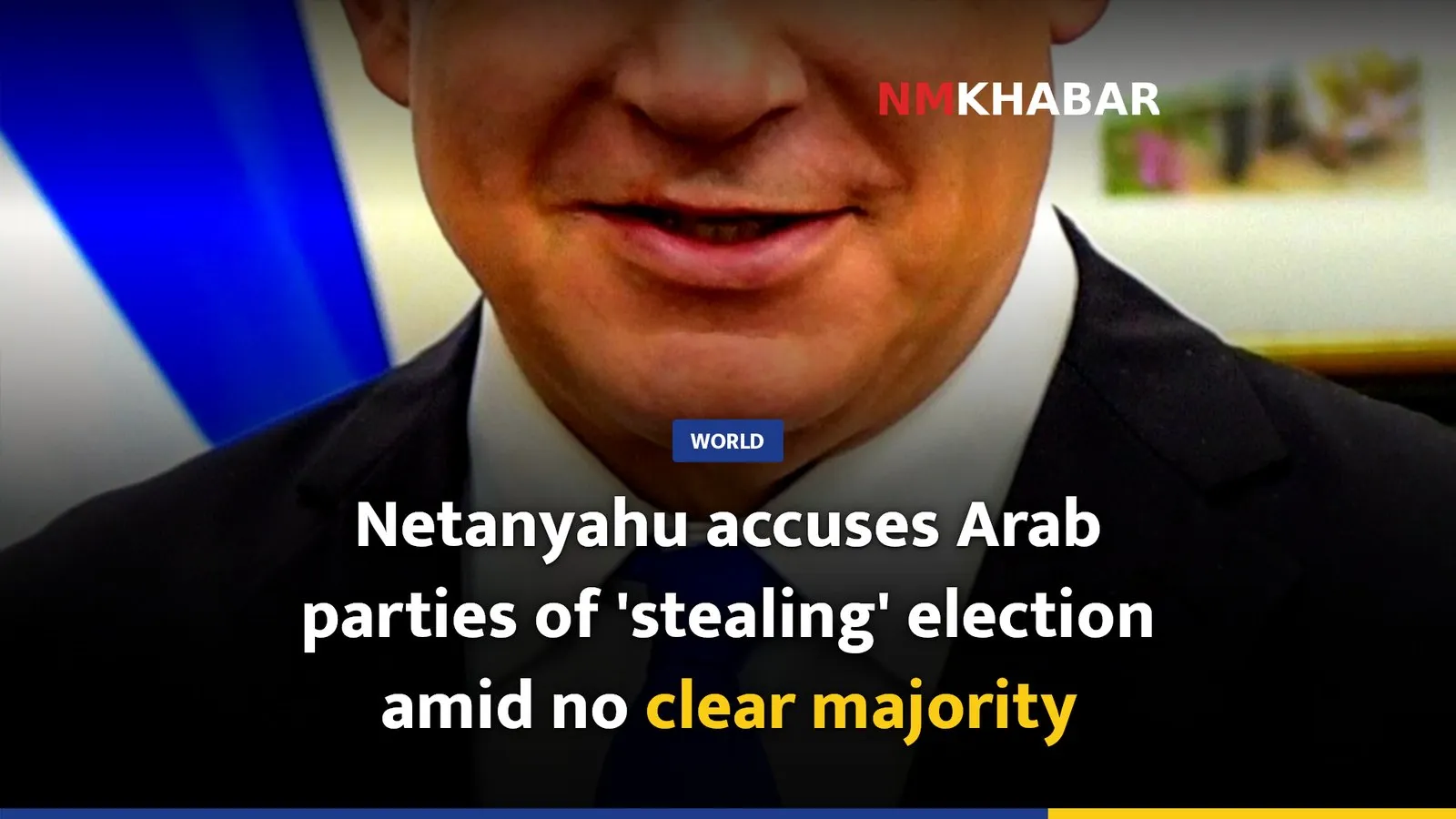
Israeli Prime Minister Benjamin Netanyahu has accused Arab parties of ‘stealing’ the recent election, demanding investigations by police and Shin Bet, Israel’s internal security agency, after his Likud party-led coalition failed to secure a majority in parliament.The accusation comes as 97 percent of the votes have been counted, showing Netanyahu’s coalition has not achieved the 61 seats required for a majority in the 120-member Knesset, Israel’s parliament. This marks a significant shift from the 2022 election, where his coalition secured 64 seats.In a statement released by the Likud party, Netanyahu claimed the election was ‘stolen by Arab parties that support terrorism and seek to destroy the Jewish state.’ He alleged this was achieved through ‘serious criminal acts such as bribery, intimidation, violence, fraud, and the use of prohibited software to attract voters.’The Likud party stated it is submitting hundreds of affidavits and evidence to the police, Shin Bet, and the Central Elections Committee to support its claims of fraud. These alleged proofs include cash-filled envelopes, Ra’am party leaflets, incidents of intimidation, violence, and double voting.Netanyahu further detailed these allegations in a statement on social media platform X. He claimed the evidence relates to alleged fraud in various polling stations within Arab communities, including ‘thousands of ballots and envelopes containing cash from the Ra’am party, threats and violence against polling station members, repeated voting behind polling booth curtains, voting using dual identities, discrepancies between the number of envelopes and voters, and the use of prohibited software to mobilize voters.’He has urged the police and Shin Bet to conduct a thorough investigation into these allegations and take legal action against those involved. Netanyahu also called on the Central Elections Committee to immediately investigate these ‘criminal activities,’ which he described as a severe blow to Israeli democracy and citizens’ voting rights.However, an official from the Central Elections Committee has rejected the claims of election fraud. It remains unclear whether further investigations will be conducted by the committee.As of 97 percent of the vote count, Netanyahu’s coalition has secured an estimated 53 seats. The opposition coalition, led by Gadi Eisenkot, is projected to win 48 seats, while the Arab parties’ coalition, comprising Ra’am and the Joint List, is expected to secure 19 seats. A total of 61 seats are needed for a majority in the Knesset.The voter turnout for this election was 77.7 percent, the highest since 1999. Approximately 600,000 special ballots, including those from soldiers, diplomats, and individuals who voted outside their registered polling stations, are yet to be counted. These votes are expected to be fully tallied by Friday.The final election results are anticipated by Thursday evening, but a clear winner is unlikely to emerge. Following the official announcement of results, Israeli President Isaac Herzog is expected to begin consultations with party leaders next week to discuss the formation of a new government. The lack of a clear majority for any bloc could lead to prolonged political negotiations or even another election.For more background on the initial election results, you can refer to our earlier coverage: https://nmkhabar.com/en/israel-election-gridlock/.The extent and nature of the investigations by the police, Shin Bet, and the Central Elections Committee into the hundreds of pieces of evidence submitted by the Likud party remain unclear. Despite the Central Elections Committee official’s rejection of fraud claims, it is not yet known whether further inquiries will proceed.The process of forming a government is also uncertain, with questions remaining about which parties will support which coalitions to achieve a majority. The role of the Arab parties could be decisive in government formation, but their alignment with any specific coalition is not yet clear.
Background
- In the 2022 election, Netanyahu's Likud party formed a coalition with various right-wing and religious parties, securing 64 seats, which was considered one of Israel's most right-wing governments.
- The recent election was influenced by the October 7, 2023, Hamas attack, which resulted in 1,200 deaths and 251 hostages.
- Critics of Netanyahu have demanded he take responsibility for security failures and called for an independent inquiry commission.
- In Israel, voters do not directly elect the Prime Minister; they vote for political parties, and seats in the 120-member Knesset are allocated based on the votes received, with a minimum of 3.25 percent of valid votes required for a party to enter parliament.