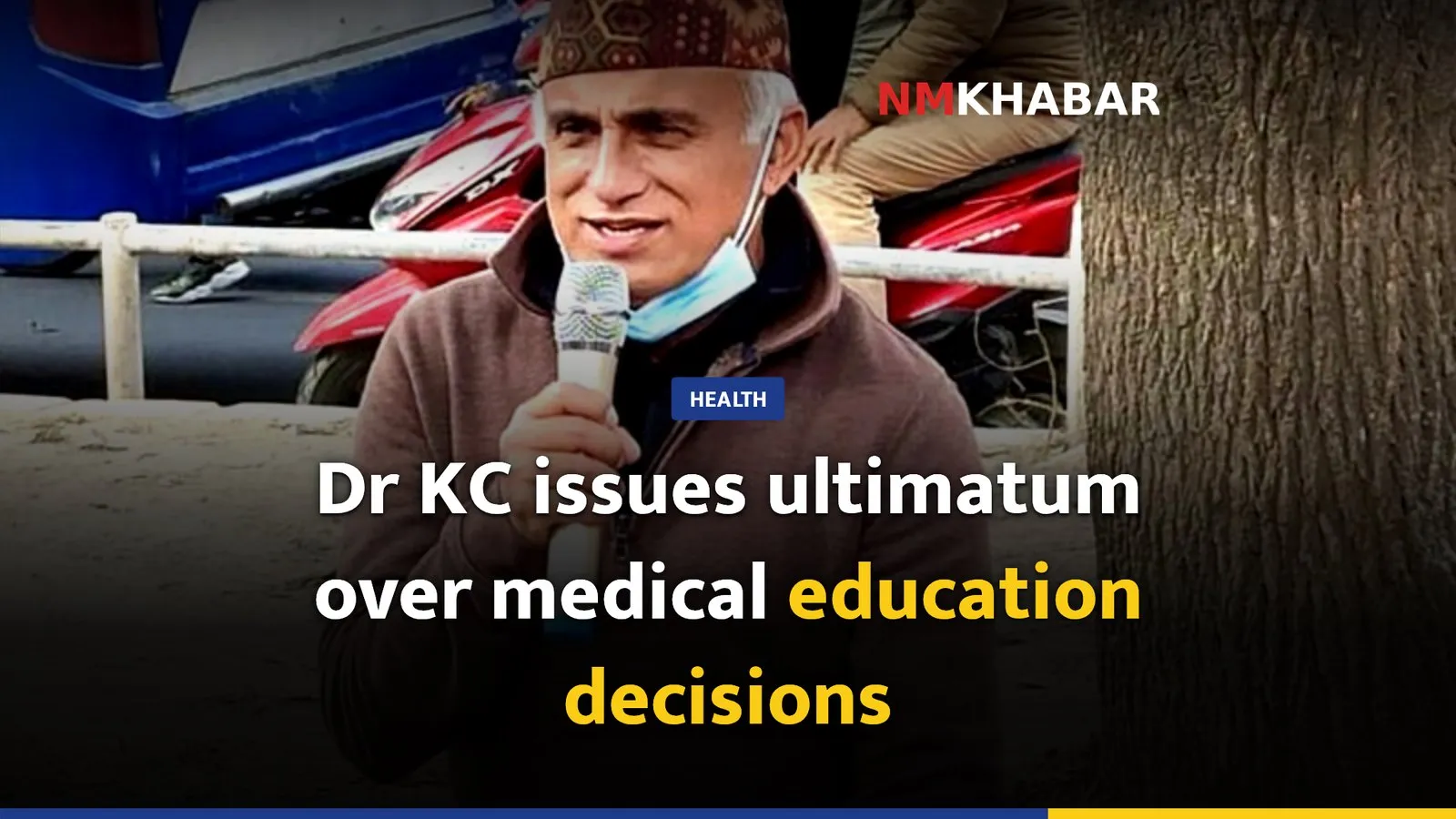
Medical education reform activist Dr Govinda KC has issued a one-week ultimatum to the government, demanding the cancellation of decisions by the Medical Education Commission (MEC) to allow MBBS programs at Shahid Dashrath Chand Health Sciences University (Geta) and increase seats at institutions including the Nepali Army Medical College.
In a statement released on Monday, Dr KC expressed serious objections to the MEC’s decision to permit MBBS and nursing programs at Geta University without adequate infrastructure, necessary human resources, and legal standards. He also called for the immediate reversal of decisions to increase seats at institutions that do not meet the required criteria.
Allegations of conflict of interest
Dr KC has raised serious questions regarding the increase in seats at institutions such as the Nepali Army Medical College, the former affiliation of the MEC’s Vice-Chairperson, Professor Dr Devendra Bahadur Khatri. According to Dr KC, Vice-Chairperson Khatri served as the principal of the Nepali Army Medical College before his appointment to the commission.
Dr KC alleges that this situation raises suspicions of a conflict of interest and misuse of authority in the decision-making process. He has called for an impartial investigation into the roles of the commission’s Vice-Chairperson and the Vice-Chancellor and Registrar of Geta University. He insists that officials found to have conflicts of interest should be immediately removed from their positions, and those found guilty in the decision-making process should face action.
Further concerns were raised by Dr KC regarding the vacant position of the commission’s director for seat allocation and the appointment of the Vice-Chairperson’s family members to the sensitive seat allocation committee. He stressed the need for an impartial investigation into these matters to ensure transparency in the decision-making process.
Unfinished business at Geta Medical College
Dr KC highlighted that the Geta Medical College and Teaching Hospital, established after nearly two decades of activism and struggle, remains unable to operate at full capacity despite its completion. The government had spent Rs 5.4 billion on its infrastructure.
He warned that the practice of temporarily bringing in academic staff from private medical colleges due to a lack of qualified personnel could severely impact the quality of medical education. Dr KC cautioned that operating academic programs without meeting minimum standards could affect the production of competent doctors and nurses, ultimately endangering public health and lives.
Dr KC emphasized the need to operate the Geta Teaching Hospital at full capacity to end the compulsion for citizens of Sudurpashchim Province to travel to Nepalgunj, Kathmandu, or India for medical treatment. He argued that the state should prioritize public health institutions to prevent citizens from facing risks of death, chronic illness, and disability due to lack of timely treatment caused by financial constraints.
Dr KC’s four-point demands
- Immediately revoke the MEC’s decision to allow MBBS programs at Shahid Dashrath Chand Health Sciences University without minimum infrastructure, necessary human resources, and legal standards. Also, immediately cancel decisions to increase seats at Nepali Army Medical College and other educational institutions.
- Conduct an impartial investigation into the roles of the commission and university officials involved in the decision-making process, and take action against those found guilty. Immediately dismiss unqualified officials and those with conflicts of interest.
- Operate Shahid Dashrath Chand Health Sciences University and Teaching Hospital at full capacity immediately, and only initiate quality academic programs after meeting all necessary standards.
- Immediately implement the agreement reached with the government on Saun 11 (BS).
Government’s inaction and future protests
Dr KC expressed strong disapproval of the government’s indifference, stating that nearly three months have passed since the agreement reached during his 24th Satyagraha on Saun 11 (BS), yet it remains unimplemented. Instead, decisions contrary to the spirit of the agreement have been made. He questioned the government’s commitment to good governance and public welfare, accusing it of making controversial decisions instead of honoring its commitments.
Dr KC warned that if his demands are not met and the agreement is not implemented within one week, he will resume his Satyagraha and other protest programs. He stated that the government would be responsible for any consequences arising from such a situation.