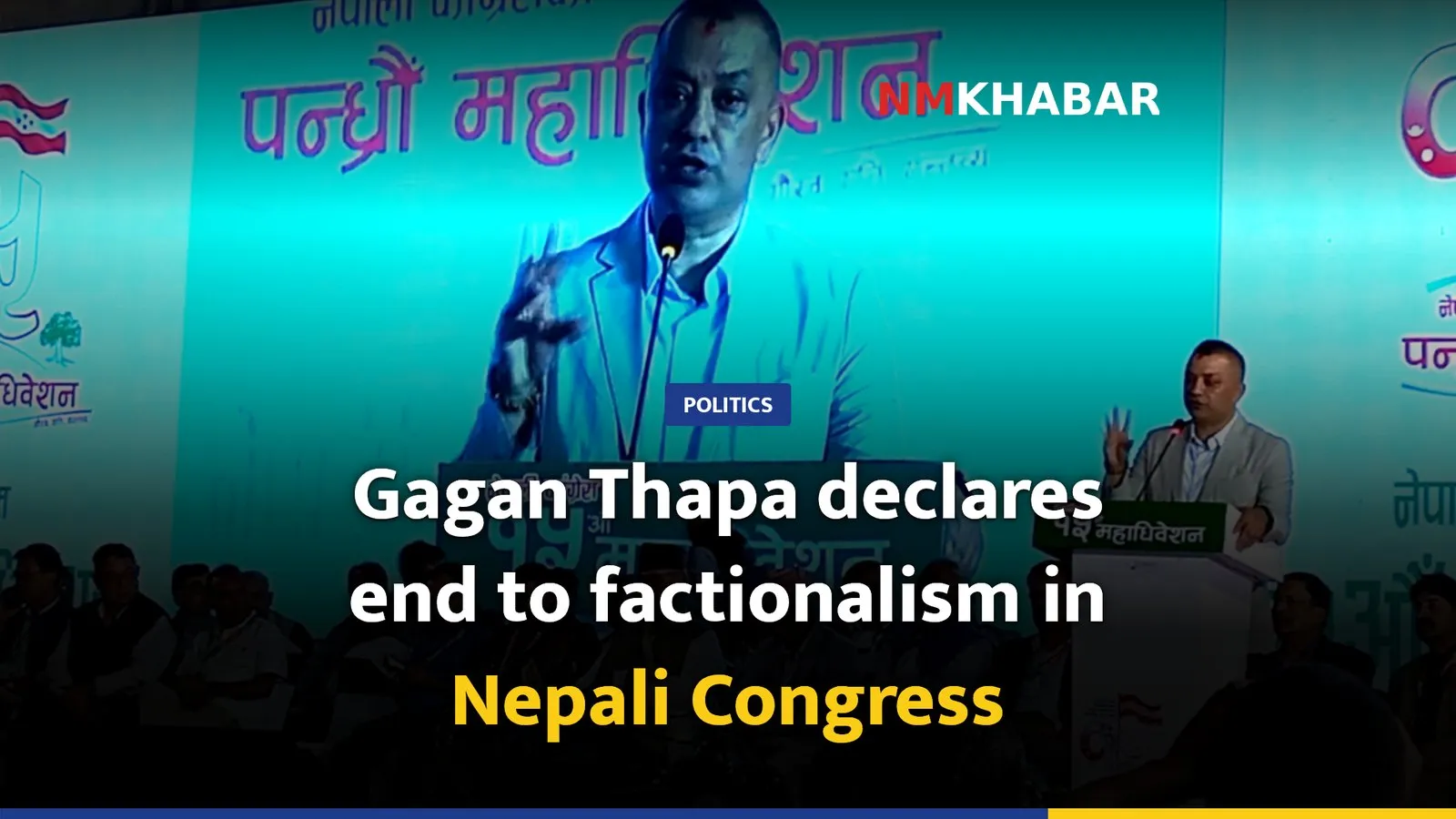
Nepali Congress (NC), a major political party in Nepal, President Gagan Thapa on Wednesday declared an end to all internal factions within the party, including those named after prominent leaders Koirala and Paudel, during the closing session of the party’s 15th General Convention in Kathmandu.
Addressing the session, Thapa asserted that “special or non-special, Koirala-Paudel, all factions are over. There are no groups. From today, all factions are finished.” He also noted observing chits being distributed promoting a “Gagan faction” during the convention and urged against such practices, stating that no such faction exists.
Thapa’s declaration signals a move to unite the Nepali Congress and shift its focus from internal divisions to broader societal and national debates. He stated his intention to dedicate a significant portion of his time to discussing the party’s policies, ideologies, and national issues outside of internal party management. He also pledged to work tirelessly for the upcoming local elections immediately after the convention concludes.
History of Factionalism
The Nepali Congress has a long history of factionalism dating back to its establishment. Internal conflicts were present even during the Rana and Panchayat eras, but they became more overt with the advent of electoral politics, particularly from 2007-2017 (BS) and post-1990. The party has split and reunited multiple times over its seven-decade history.
Notable splits include the one caused by Dr. Dilli Raman Regmi’s faction in 2004 (BS) and the formation of Nepali Congress (Democratic) by then-President Sher Bahadur Deuba in Asar 2059 (BS), following disagreements with Girija Prasad Koirala. The two factions reunited in Asoj 2064 (BS). The terms “Chhattise, Chauhattare, Deuba faction” mentioned by Thapa refer to these long-standing power centers and factional divisions within the party.
The 15th General Convention of the Nepali Congress began on Sunday, Asar 18 (BS), at Khulamanch, Kathmandu, and was scheduled to conclude by Asar 22 (BS). The closing session on Wednesday was temporarily suspended due to heavy rain and strong winds, which also affected the candidate registration process for various positions, including party officials.
Current Divisions and Future Plans
Despite Thapa’s declaration, the party faces ongoing internal divisions. A group close to former party president Sher Bahadur Deuba has reportedly not accepted Thapa as president and is preparing for a separate general convention. This current schism is attributed to the prolonged lack of leadership transfer and Deuba’s reluctance to easily relinquish his position. The party was reportedly compelled into a special general convention due to demands from 54 percent of delegates, a move that has further exacerbated the split.
The General Convention’s main agenda includes discussing and approving various organizational and policy reports, after which the election process for leadership selection is expected to proceed. While Thapa has committed to working for local elections, the specific date for these elections in 2083 BS remains unclear. The full details of the elected officials from the 15th General Convention are yet to be announced as the election process is ongoing. Similarly, the detailed schedule and full list of leaders participating in the separate convention planned by the Deuba group are not yet clear.
The Nepali Congress has also seen its influence wane in Madhesh Province, where it secured only one out of 32 seats in the 2082 elections, a significant drop from its previous dominance. Analysts attribute this decline to the party’s indifference to the Madhesh movement, its leadership’s feudal tendencies, persistent factionalism, and a growing disconnect with the public.