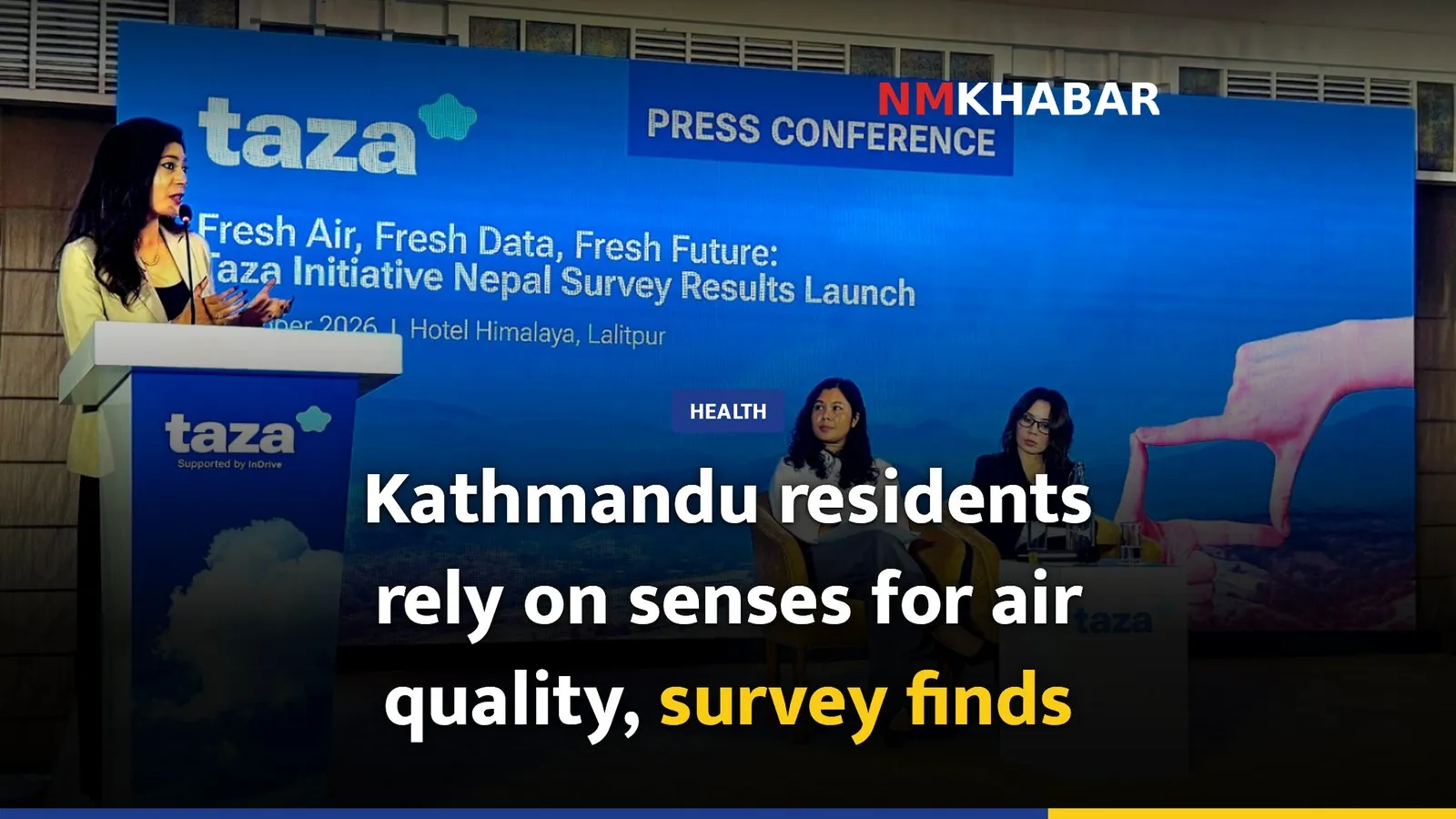
Kathmandu Valley residents overwhelmingly perceive air pollution as harmful to their health, yet a new survey reveals that most rely on their senses rather than official data to gauge air quality. The survey, conducted by Taja Initiative Nepal, a non-profit organization established in 2026, highlights a significant gap between public concern and access to reliable information.
The survey of 1,200 Kathmandu Valley residents found that 81.2 percent believe the air pollution is harmful to extremely harmful for their health. However, among those who check air quality, a striking 94.1 percent depend on sensory experiences such as smell, visibility, and eye irritation, rather than official data. Overall, 52.3 percent of residents rated their local air quality as poor to very poor, with this perception being higher in major urban areas like Lalitpur (60.9 percent), Kathmandu (59.2 percent), Bhaktapur (56.0 percent), and North Kathmandu (35.9 percent).
Knowledge about how to check air quality also varied significantly with educational background. Only 10.8 percent of respondents with primary education or less knew how to check air quality, compared to 63.0 percent of those with postgraduate or higher education. Younger demographics showed a greater tendency to monitor air quality digitally, with 60.3 percent of actively tracking respondents aged 18-24 using websites and 42.5 percent using mobile apps. However, these figures represent only 14.1 percent and 10.0 percent, respectively, of that age group, indicating a large number of people do not monitor air quality at all.
Motor vehicles and traffic emissions were identified as the primary source of air pollution by 98.6 percent of respondents, followed by dust from road construction at 94.8 percent. Public support for institutional measures to control air pollution is strong, with 79.9 percent backing the expansion of public transport and electric mobility, and 71.5 percent supporting stricter dust control measures and urban greenery. Despite this, 70.4 percent expressed dissatisfaction with the government’s current efforts to reduce air pollution.
Regarding personal protective measures, 82.0 percent of respondents rely on surgical masks or scarves. However, 43.4 percent reported taking no personal steps to protect themselves from air pollution. The survey also suggests that air pollution influences residents’ decisions to leave the Kathmandu Valley. Among the 7.2 percent considering moving out, 39.1 percent cited poor air quality as a reason, making it the second most significant factor after economic pressure and high cost of living (47.8 percent).
Roshani Giri, Executive Director of Taja Initiative Nepal, stated that the survey reveals a critical disconnect. “Four out of five residents say the air is harmful to their health, yet most people are forced to rely on their senses rather than science to understand the air they breathe. Six out of ten do not know how to check pollution levels,” Giri said. Taja Initiative Nepal aims to make air quality data more accessible, understandable, and actionable for Kathmandu Valley residents. Based on the findings, the organization plans to expand air quality research, develop accessible data platforms, and conduct air quality literacy programs across the Valley.
Kathmandu’s pollution context
The survey findings come as Kathmandu continues to grapple with severe air pollution. On October 7, 2026, Kathmandu was listed as the world’s second most polluted city, with an overall Air Quality Index (AQI) of 177. In 2025, Nepal’s annual PM2.5 concentration was 7.5 times higher than the World Health Organization’s PM2.5 guidelines. Air pollution was linked to 42,100 deaths in Nepal in 2019, according to the ‘State of Global Air–2020’ report. The Kathmandu Valley typically experiences intensified air pollution during the winter months (Ashoj to late Magh BS), due to atmospheric inversion trapping pollutants close to the ground.
Government initiatives and future plans
The Ministry of Forests and Environment, Nepal’s government body responsible for forest conservation and environmental management, has prepared new standards to control environmental pollution and is seeking feedback on them. These standards include guidelines for industrial furnaces, boilers, brick industries, cement industries, and national air quality standards for 2082 (BS). The ministry is also drafting a ‘Vibrant Sagarmatha: Nepal Mountain Resilient Strategy, 2026’. The Department of Environment plans to increase monitoring of vehicles and industries, particularly from Mangsir to Jestha (BS), when air pollution is high. There are plans to expand the current 30 air pollution monitoring stations to 56. A revised Air Quality Management Action Plan for the Kathmandu Valley is set for implementation, and a national air quality action plan is being developed. Studies on cross-border air pollution are also underway.
Unanswered questions
Detailed official Air Quality Index (AQI) data for all locations in the Kathmandu Valley for October 7, 2026, is not publicly available, despite Kathmandu being listed as the world’s second most polluted city. The detailed implementation schedule and final framework for the new standards prepared by the Ministry of Forests and Environment, and the ‘Vibrant Sagarmatha: Nepal Mountain Resilient Strategy, 2026’, have not yet been released. Furthermore, the detailed action plan and timeline for the Department of Environment’s increased monitoring efforts remain unclear, and the conclusions of the cross-border pollution studies have not been made public.