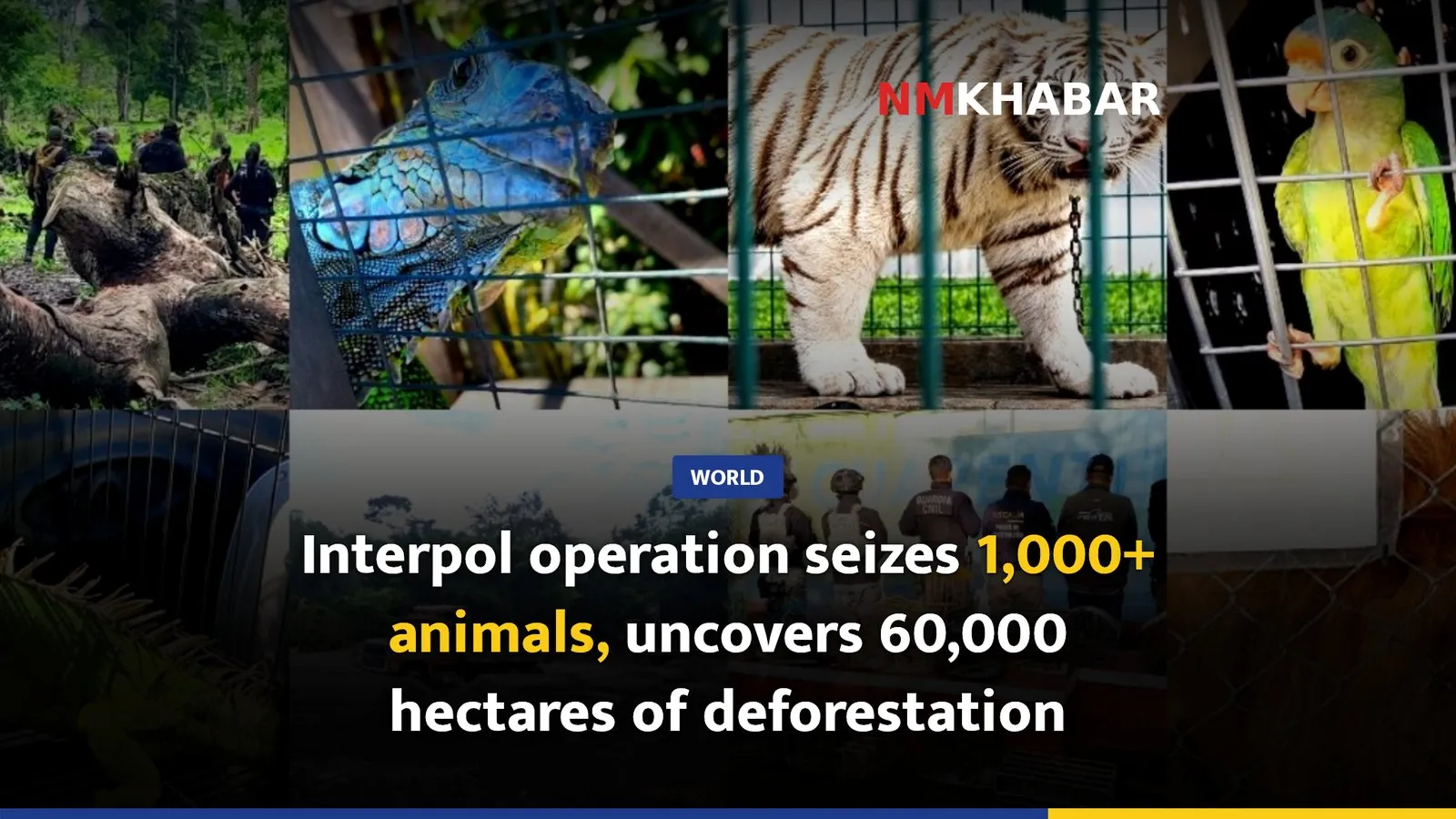
An Interpol operation across nine countries in Latin America and the Caribbean resulted in 233 arrests, the seizure of over 1,000 live animals, and the discovery of 60,000 hectares of illegal deforestation. The operation, dubbed ‘Madre Tierra VIII’, ran from June 1 to July 31, targeting networks involved in illegal wildlife trafficking and large-scale deforestation.
The participating countries included Colombia, Costa Rica, the Dominican Republic, El Salvador, Guatemala, Honduras, Mexico, Nicaragua, and Panama. Investigators identified extensive networks engaged in illegal timber and wildlife trafficking operating across the region connecting Central and South America.
Interpol estimates that illegal wildlife trade was the fourth most profitable crime and trafficking industry in 2023, with an annual turnover of 23 billion US dollars.
Extensive illegal activities uncovered
During the operation, 312 individuals were identified as suspected of involvement in environmental crimes. A total of 313 items were seized, including approximately 4.6 tonnes of cyanide, mercury, and ammunition. Interpol stated that by connecting information from various countries, investigators identified networks involved in illegal deforestation, mining, and wildlife trafficking. Investigations also targeted individuals and companies profiting from these activities.
In Colombia, investigations focused on 11 foreign companies suspected of illegally deforesting over 52,000 hectares of protected Amazonian forest. This led to the discovery of connections with an additional 161 companies and 65 individuals, with 16 arrests made in Colombia during the operation.
Costa Rica saw the seizure of 11 containers holding approximately 4.6 tonnes of cyanide and mercury, used for illegal gold extraction. In Mexico, various species of big cats, including tigers, lions, ocelots, and jaguars, were recovered.
Nicaragua yielded the recovery of various exotic birds, including parrots and green and red macaws. Additionally, approximately 165 kilograms of dried shark fins were seized, with an estimated value of 280,000 US dollars, according to Interpol.
Nepal’s vulnerability to wildlife trafficking
Nepal serves as both a source and transit route for wildlife trafficking, particularly for products moving from India towards China. Nepal recorded 61,767 environmental crime incidents in 2020-21, which increased to 64,471 within 12 months. Between 2018 and 2020, 2,054 cases were registered for illegal hunting or trafficking of wildlife, leading to the arrest of 3,836 suspects.
Thomas Ungerbuheler, Interpol’s Assistant Director of Environmental Security, emphasised the necessity of cooperation among countries to identify and control cross-border environmental crime networks. He stated that such international collaboration is crucial for tackling these issues.
Financial crime and future actions
Nepal Rastra Bank, the central bank, has highlighted that financial crime and money laundering severely impact the banking system and social fabric of developing nations. Dr. Bishwanath Paudel, Governor of Nepal Rastra Bank, stressed the need for preventive supervision and a risk-based supervisory system that does not hinder financial inclusion to curb borderless financial crime. The central bank issued guidelines for environmental and social risk management for banks and financial institutions in 2075 (BS) and revised them in 2079 (BS) to make risk assessment mandatory for loans exceeding Rs 10 million.
South Asian countries have also pledged to intensify regional efforts against illegal wildlife trade, including strengthening intelligence sharing, coordinated enforcement, financial investigations, and criminal justice cooperation. The South Asia Wildlife Enforcement Network (SAWEN), an intergovernmental organisation comprising Afghanistan, Bangladesh, Bhutan, India, Maldives, Nepal, Pakistan, and Sri Lanka, has decided to observe Magh 17 (January 30) annually as SAWEN Day. SAWEN member states have also approved the SAWEN Implementation Plan 2026-2030.