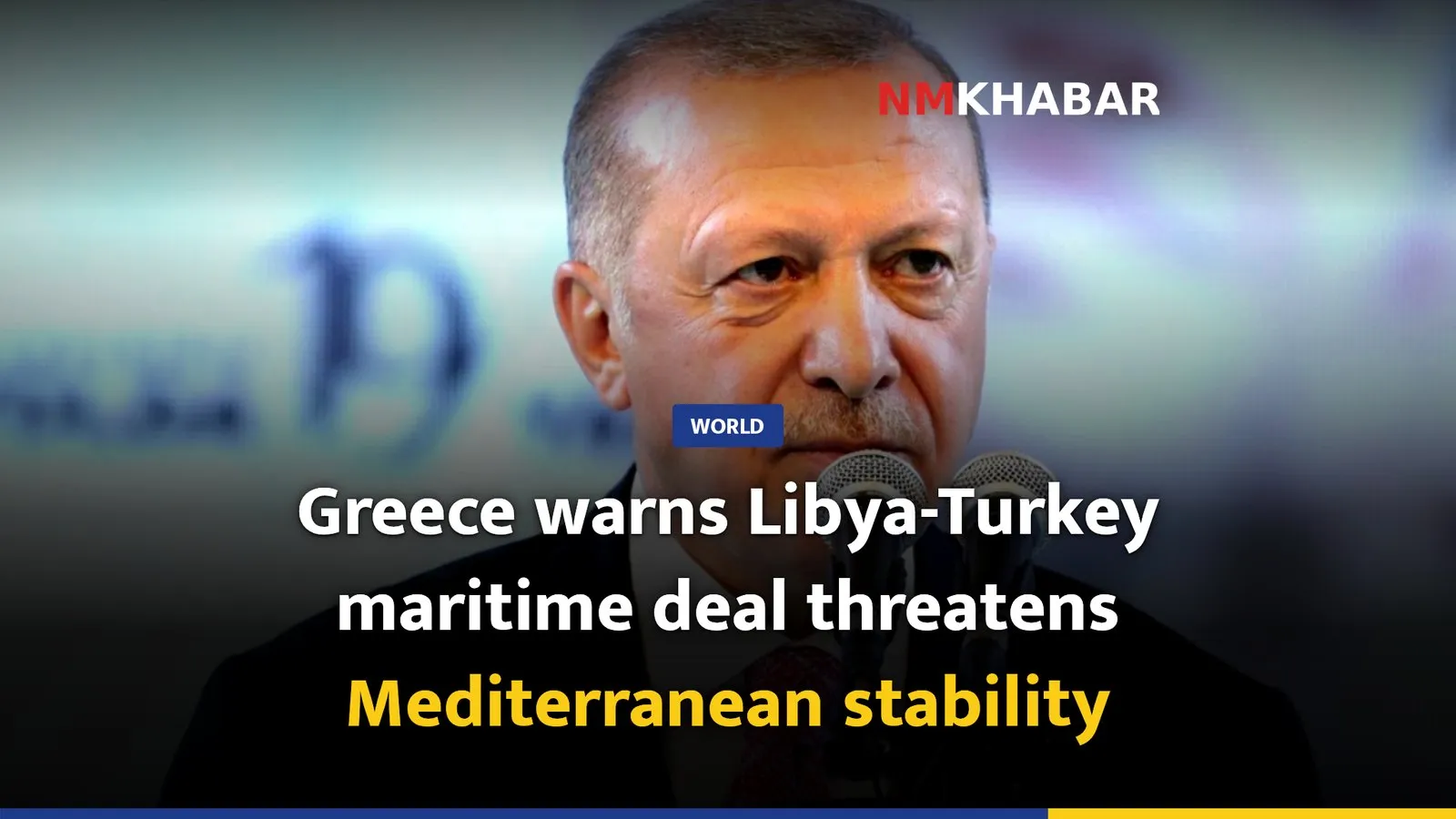
Greece warned on Monday that Libya’s approval of a disputed maritime agreement with Turkey threatens stability in the Mediterranean. Greek Foreign Minister George Gerapetritis told reporters in New York that the vote by Libya’s House of Representatives to finally ratify a 2019 preliminary agreement with Turkey “raises serious concerns for regional security and stability.”Mr. Gerapetritis added that the deal highlights a “broader challenge to the international legal order, ensuring that arbitrary bilateral arrangements do not undermine established rules of international law or prejudice the rights of other states.” Bahrain, Cyprus, Egypt, the European Union (EU), and the United Arab Emirates (UAE) issued a joint statement with Greece on the matter.The agreement, signed in 2019 by Ankara and the internationally recognised Libyan government in Tripoli, western Libya, establishes a maritime corridor between Turkey’s southern coast and Libya’s northern coast. This allows the two countries to assert economic rights over potentially lucrative oil and gas reserves beneath the Mediterranean seabed. Libya’s rival eastern administration, led by military commander Khalifa Haftar, had opposed the agreement for years. However, on October 20, 2026, Libya’s eastern parliament approved the 2019 maritime boundaries agreement, reversing its long-standing opposition.The deal has fueled tension with neighboring countries, particularly Greece, Egypt, and Cyprus. Mr. Gerapetritis stated that the agreement ignores the maritime entitlements of Greek islands, which are protected under the UN Convention on the Law of the Sea, a framework used to arbitrate territorial disputes. A diplomat, who requested anonymity due to the sensitivity of the matter, told The National that Turkey and Libya have no adjacent or opposite coasts, and therefore no common maritime boundaries. The diplomat described the proposed maritime boundary as a “blatant refashioning of geography” that violates international maritime law, rendering the agreement “null and void” and without legal consequences.The agreement could also complicate plans for the EastMed pipeline, a proposed project to transport natural gas from Israel and Cyprus through Greece to Europe. This pipeline is intended to strengthen Europe’s energy security, but its planned route crosses waters claimed by Turkey and Libya under the deal.The EU has also criticized the agreement, stating that it violates the sovereign rights of third countries and does not comply with the law of the sea. UN Secretary-General Antonio Guterres told reporters on Monday in Cairo that violations of international law governing maritime agreements were unacceptable, and agreements incompatible with the convention should not be recognized or accepted.Egypt, a long-time supporter of the eastern Libyan authorities, rejected the deal last week, stating it was null and void and would have no legal effect in Cairo. Cairo and Athens had signed their own maritime delimitation agreement in August 2020.Turkish President Recep Tayyip Erdogan stated on Monday that criticism from the EU and others had “no legitimate basis.” He added that Turkey is not seeking to score points against anyone in the eastern Mediterranean and that those seeking to exclude Turkey from the region must respect the will of Ankara and Libya. Libya’s UN envoy, Taher El Sonni, defended the agreement to The National, calling it a “sovereign decision.” He suggested that countries challenging it should pursue legal avenues, including the International Court of Justice.An estimated 5,000 Nepalis reside in Greece, with approximately 4,000 working undocumented in the agricultural sector. In 2024, Greece earned 712 million euros from 80,000 tons of strawberries, largely due to low-wage migrant workers. Human trafficking networks are active in bringing Nepali workers to Greek villages. While the Greek government allocated quotas for 89,000 migrant workers from non-EU countries in 2025, including 41,670 general workers and 45,620 seasonal workers, Nepal’s policy of not sending workers for only nine months seasonally makes it difficult for Nepalis to be legally recruited under these quotas. Reports from December 2025 indicated exploitation of Nepali workers on strawberry farms in Greece, lured by promises of high income. In December 2024, a Nepali worker died in Greece and was buried by Greek authorities without informing his family. The number of Nepali migrant worker deaths abroad increased from 672 to 1,346 between 2023 and 2024.The long-term implications of the Turkey-Libya maritime agreement on energy exploration and regional influence for Israel, Greece, Cyprus, and Egypt remain unclear. Greek Foreign Minister George Gerapetritis will chair a high-level open meeting of the UN Security Council on ‘Children and Armed Conflict’ on October 26. On October 27, he will chair a second high-level open debate on ‘Women, Peace and Security,’ where further diplomatic discussions on this issue may occur.
Greece warns Libya-Turkey maritime deal threatens Mediterranean stability
Greece has warned that Libya's approval of a disputed maritime agreement with Turkey threatens stability in the Mediterranean, drawing criticism from several international bodies.
Nmkhabar English Desk
4 min read
Size:
Nmkhabar English Desk
Correspondent · Nmkhabar
NM Khabar English desk. Stories are prepared with AI assistance and checked against their sources — how we work: https://nmkhabar.com/ai-policy/ . Report an error: info@nmkhabar.com