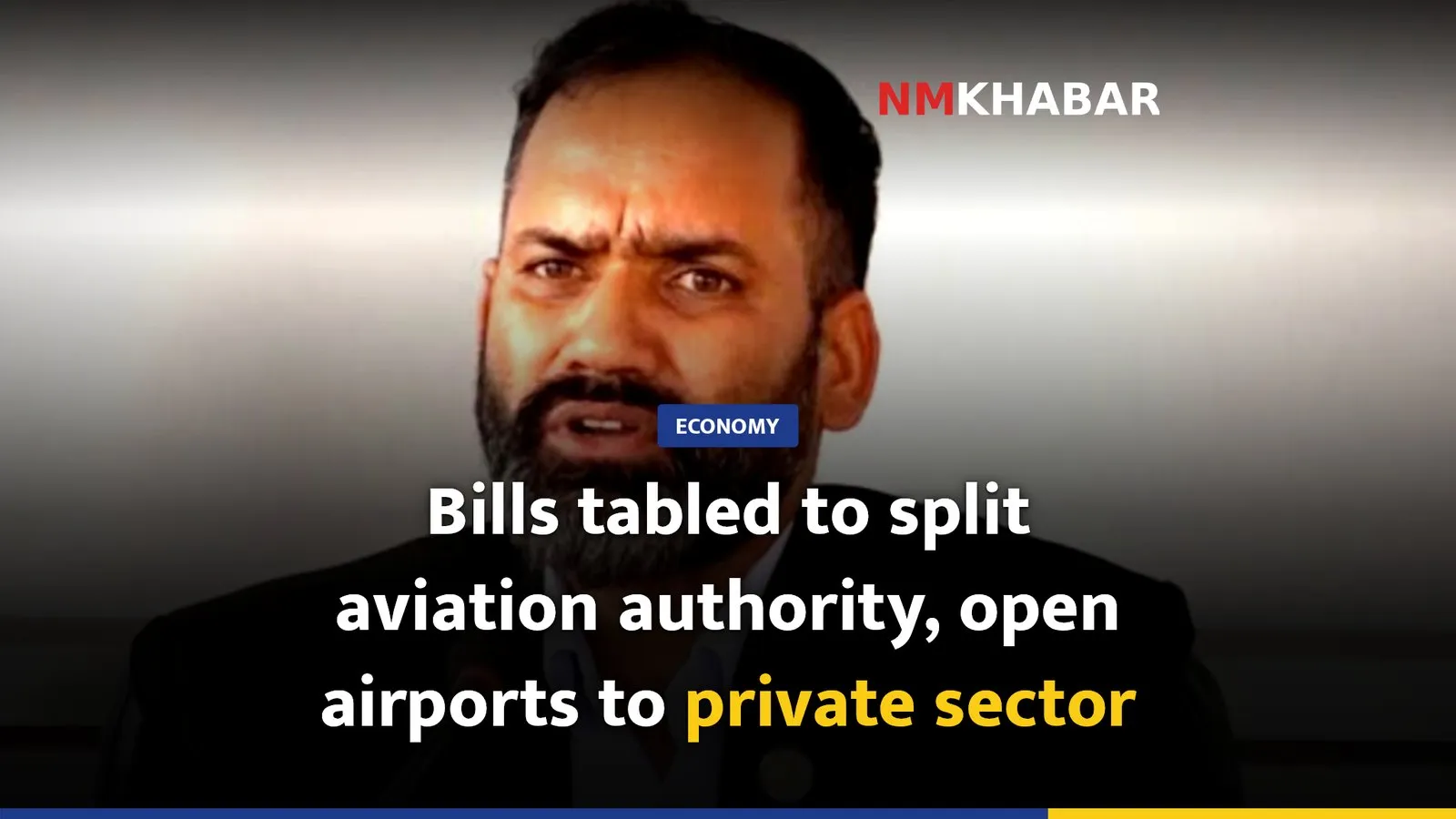
The government has tabled two bills in the House of Representatives, the lower house of parliament, to split the Nepal Civil Aviation Authority (CAAN) into two autonomous bodies: one for regulation and another for service provision. The proposed legislation also opens the door for the first time for private sector involvement in the construction, operation, and management of airports across the country.
Khadakraj Paudel, the Minister for Culture, Tourism and Civil Aviation, registered the ‘Nepal Civil Aviation Authority Bill’ and the ‘Nepal Air Service Authority Bill’ with the Parliament Secretariat on Ashoj 16 (BS). If passed, the existing CAAN will be dissolved, and two new entities will be established: the Nepal Civil Aviation Authority for regulatory functions and the Nepal Air Service Authority for service delivery.
The ‘Nepal Air Service Authority Bill’ specifically allows the new Air Service Authority to operate and manage domestic and international airports either independently or in partnership with the private sector. This new provision would enable private entities to operate airports, including bringing in international investment for their development and management, a departure from the current government-only operational model.
Addressing International Safety Concerns
This legislative initiative is primarily aimed at addressing long-standing concerns raised by international aviation bodies, particularly the International Civil Aviation Organization (ICAO) and the European Union (EU). Both organizations have consistently highlighted CAAN’s dual role as both a service provider (operating airports) and a regulator as a significant safety risk.
Nepal has been on the EU’s aviation safety blacklist since 2013, which prohibits Nepali airlines, including the national flag carrier Nepal Airlines Corporation, from flying in European airspace. The Ministry of Culture, Tourism and Civil Aviation expects that the passage and implementation of these bills will pave a clear path for Nepal to be removed from the EU’s blacklist and restore the international credibility of Nepali airlines.
New Roles and Responsibilities
Under the proposed legislation, the new Nepal Civil Aviation Authority will be responsible for flight safety and regulation, overall civil aviation security supervision, licensing and certification, technical licensing, enforcement, and auditing. It will issue Air Operator Certificates to airlines, register aircraft, certify airworthiness, and provide licenses and ratings to pilots, air traffic controllers, and engineers. This authority will also have quasi-judicial powers to impose fines and suspensions on airlines or entities violating safety standards.
The Nepal Air Service Authority, on the other hand, will be tasked with the construction, upgrade, maintenance, and daily operation and management of domestic and international airports nationwide. Its responsibilities will include air traffic control, communication for flight operations, navigation and aviation meteorological services, airport security management, fire control, and search and rescue services. It will also collect landing, parking, navigation, and passenger service fees and utilize commercial structures.
Background and Next Steps
This is the third attempt to split CAAN, with previous bills tabled in February 2020 and February 2025 failing to pass due to the dissolution of the House of Representatives. Given the current government’s nearly two-thirds majority, these bills are expected to pass smoothly through parliament.
Once the bills are enacted into law, all current CAAN employees will be adjusted into the new Air Service Authority. Employees wishing to join the regulatory body must apply within 60 days of the law’s promulgation. The proposed acts will come into effect 91 days after presidential authentication. Detailed discussions on the bills are expected to take place among parliamentarians.