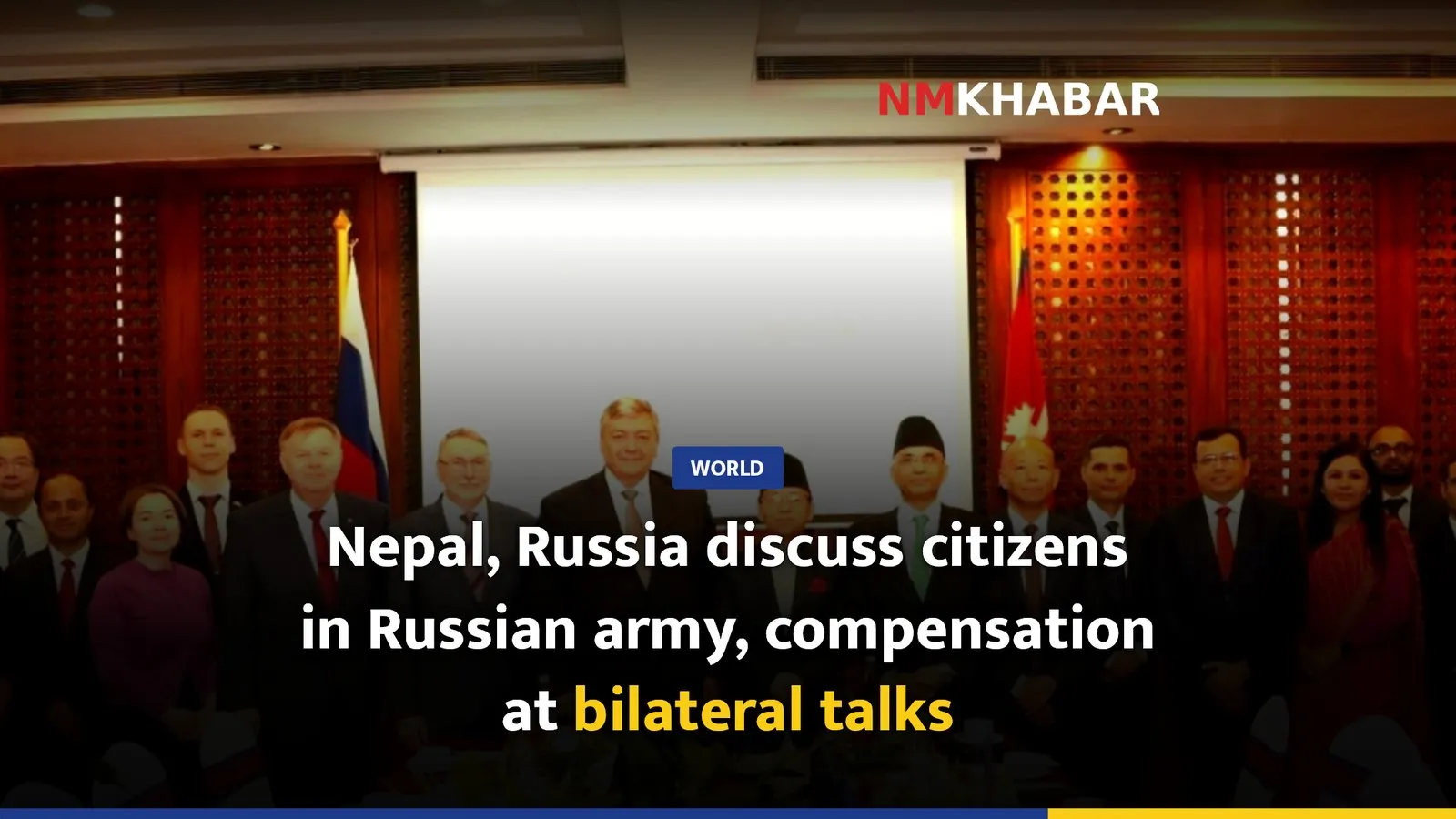
Nepal and Russia held a bilateral consultation meeting in Kathmandu on Wednesday, October 7, 2026, to discuss the welfare of Nepali citizens serving in the Russian army, including those missing and held as prisoners of war in Ukraine. The two nations also addressed compensation for deceased Nepali soldiers.The third meeting of the Nepal-Russia Bilateral Consultation Mechanism reviewed the overall aspects of Nepal-Russia relations, coinciding with the 70th anniversary of the establishment of diplomatic ties between the two countries. During the consultations, discussions covered Nepali citizens in the Russian army, missing Nepali citizens, those detained as prisoners of war in Ukraine, and the issue of compensation, the Ministry of Foreign Affairs said in a statement issued on Wednesday.Foreign Secretary Amrit Bahadur Rai led the Nepali delegation, while Russia’s Deputy Foreign Minister Andrei Rudenko headed the Russian side. The Russian delegation included Alexey Surovtsev, Russia’s Ambassador to Nepal, and officials from the Russian Ministry of Foreign Affairs. Ganesh Prasad Dhakal, head of the Europe Division at Nepal’s Ministry of Foreign Affairs, was part of the Nepali delegation. Both sides praised the long-standing friendship and close partnership between their countries.Deputy Foreign Minister Rudenko informed Nepal that Russia would provide 52 scholarship quotas for Nepali students for the upcoming academic year. He also expressed condolences for the loss of life and property caused by recent floods in Nepal, stating Russia’s readiness to provide necessary assistance. Both sides committed to further promoting cooperation in education, human resource development, culture, tourism, climate change, trade, and investment.
Nepali Casualties and Compensation
According to a Ministry of Foreign Affairs source, 40 Nepali citizens who enlisted in the Russian army have died in the Russia-Ukraine war as of September 2, 2024. Additionally, 57 bodies are undergoing DNA testing for identification, and families of 118 missing Nepalis have filed requests for their search with the Ministry of Foreign Affairs’ Consular Department. Seven Nepali citizens are currently held captive by Ukrainian forces.Russia has agreed to provide compensation to the families of Nepali citizens killed in the war through Nepali government mechanisms. Although the exact amount of compensation has not been disclosed, it is expected to be equivalent to what Russian soldiers’ families receive. Russia also ceased new recruitment of Nepali citizens from May 2025 and has not renewed contracts after one year, leading to Nepalis returning to Moscow from the battlefield.
Background on Recruitment and Relations
Diplomatic relations between Nepal and the Soviet Union (now Russia) were established on July 20, 1956. In 2022, Russia enacted a law offering Russian citizenship within one year to foreign citizens willing to join its army. The promise of good salaries and Russian citizenship attracted Nepali citizens to enlist. The number of Nepalis joining the Russian army significantly increased around May 2024 after a plan was announced to grant permanent residency to foreign citizens serving for one year.The Government of Nepal sent a diplomatic note to Russia in late 2024, urging it to halt the recruitment of Nepali citizens into its army and to repatriate those already enlisted. The consultation protocol between Nepal and Russia, aimed at regular consultations and exchange of views on bilateral, regional, and international issues, was signed in 1995. The first meeting of this mechanism took place in Moscow in 2007, and the second was held in Kathmandu on April 17, 2018. The Russia-Ukraine war began in February 2014, with Russia launching a full-scale invasion of Ukraine on February 24, 2022.While Russia has agreed to compensation, the exact amount and the timeline for its distribution remain unclear. Similarly, the precise number of Nepali citizens currently serving in the Russian army is not officially known, with estimates ranging from former Prime Minister Pushpa Kamal Dahal’s statement of approximately 200 in December 2023 to over 700 according to Nepalis in the war zone. The timeline for the repatriation of Nepali citizens from the Russian army and the release of those held as prisoners of war in Ukraine is also yet to be clarified.