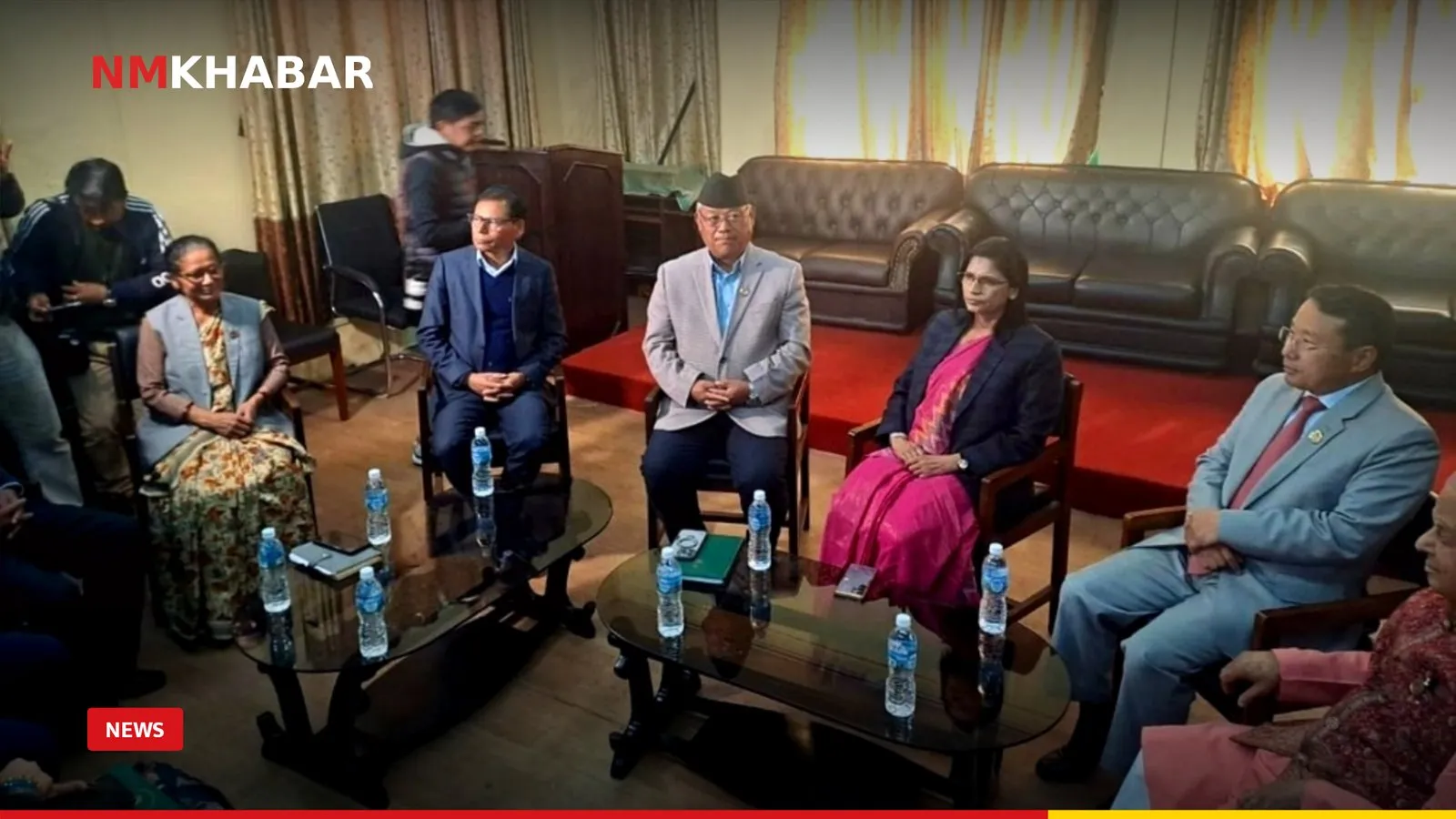
Opposition parties have accused the government of attempting to rule by ordinance and demanded an immediate federal parliament session. The demand came from a meeting of opposition leaders held at the Nepali Congress parliamentary party office in Singha Durbar.
The meeting, convened by the main opposition Nepali Congress, discussed several contentious issues, including the recent arrests of journalists, alleged involvement of middlemen with the government, and discussions around impeaching judges.
Controversies discussed
Opposition leaders criticized the government’s actions, particularly the police entering various media houses and arresting journalists on Friday, Kartik 13 (BS). Journalists Bishwamani Subedi of Nepal Press, Shobhraj Baral of Motivate News, and Dhiraj Basnet of DNA Khabar were arrested. Information and Communications Minister Dr. Bikram Timilsina confirmed that all arrested journalists were released on Kartik 13 (BS). Prime Minister Balen Shah had also instructed relevant bodies not to harass journalists.
Another major point of discussion was the alleged nexus between middlemen and judges. The Rastriya Swatantra Party (RSP) has intensified discussions for the impeachment of judges linked to middleman Inam Sapkota. The RSP formally decided on Kartik 16 (BS) to initiate impeachment proceedings against the controversial judges. However, Nepali Congress parliamentary party leader Bhishma Raj Angdembe stated that the Nepali Congress would only make its stance public after observing the RSP’s decision and actions.
Ordinance rule allegations
Opposition parties allege that the government is trying to govern through ordinances after the federal parliament’s session concluded on Friday, Ashoj 16 (BS), at midnight. Since then, the government has issued three ordinances:
- The ‘Ordinance to Amend Some Nepal Acts Related to Disaster, 2083’ on Ashoj 30 (BS).
- The ‘Constitutional Council (Functions, Duties, Powers and Procedures) (First Amendment) Ordinance, 2083’ on Baishakh 23 (BS).
- The ‘Money Laundering Prevention (Third Amendment) Ordinance, 2083’ on Baishakh 22 (BS).
Nepali Congress parliamentary party leader Bhishma Raj Angdembe stated that the meeting aimed to form a common understanding on government activities that intimidate the private sector, employees, and media, as well as the prevailing irregularities in the judiciary.
Participants and next steps
Leaders from the Nepali Congress, CPN-UML, CPN, Rastriya Prajatantra Party (RPP), Janata Samajbadi Party (JSP), Rastriya Janamorcha, and Loktantrik Samajbadi Party (LSP) participated in the meeting. JSP, Rastriya Janamorcha, and LSP leaders were present only from the National Assembly, the upper house of parliament.
The opposition parties have urged the government to call an immediate session of the federal parliament. While the opposition prepares to demand a parliamentary investigation into the controversial issues, the government is reportedly preparing to call the parliament session only in the second week of Mangsir (BS).
The government’s response to the opposition’s accusation of ruling by ordinance is not yet clear. Further details regarding other individuals or bodies allegedly connected to the middleman scandal are also unavailable. The specific judge against whom the RSP plans to initiate impeachment proceedings has not been publicly identified. The exact date for the federal parliament session has not been fixed.
Background
- The federal parliament's session concluded on Friday, Ashoj 16 (BS), at midnight.
- Police entered various media houses and arrested journalists on Friday, Kartik 13 (BS), who were later released.
- Controversy arose after alleged connections between middleman Inam Sapkota and high-ranking government officials, including Supreme Court judges, became public.