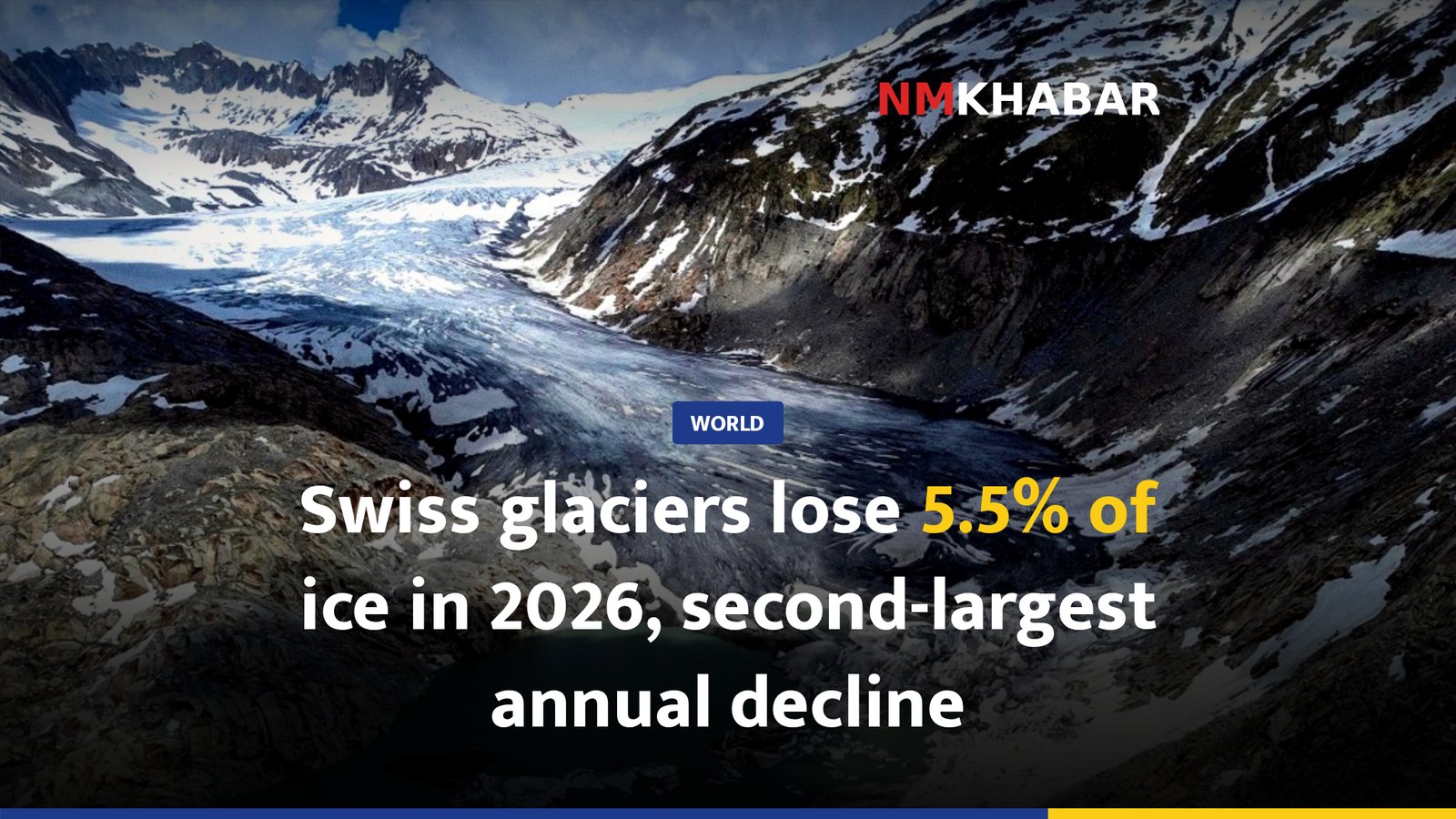
Switzerland’s glaciers lost 5.5% of their total ice volume in 2026, marking the second-largest annual decline on record, driven by extreme heat and low winter snowfall. This alarming rate of melt was detailed in a report released on Thursday, October 1, 2026, by GLAMOS, Switzerland’s glacier monitoring service, and the Swiss Academy of Sciences.
The 2026 loss follows a record 6% reduction in 2022. Over the past five years alone, Swiss glaciers have shed nearly 20% of their total ice volume. The report indicated that the average thickness of individual glaciers decreased by 2.5 to 4 meters this year, with some frontal parts experiencing a reduction of up to 10 meters. Several smaller glaciers, including Bela Tola in Valais and Grisfirn in Glarus, completely disappeared in 2026. The Aletsch, Allalin, Clariden, and Rhone glaciers were among those that experienced the most significant ice loss.
From July to September 2026, an estimated 2.2 trillion liters of water equivalent ice melted from Switzerland’s glaciers. This volume is four times the annual water consumption of Swiss households. The severe melt is attributed to the winter of 2025-2026, which recorded one of the ten lowest snowfalls since measurements began, coupled with dry conditions and at least one heatwave every month from May to September 2026. The snow line remained above 4,000 meters for a record 76 days during this period.
Impact on Water and Energy
Matthias Huss, director of GLAMOS and a professor of glaciology at ETH Zurich, warned that Alpine glaciers cannot sustain their current state. He directly linked the observed temperature increases to human-induced climate change, stating that such warming would not occur without human emissions and the use of fossil fuels. The lack of sufficient winter snow is a particular concern, as snow protects older ice from melting and provides a crucial base for new ice formation at high altitudes.
Switzerland is often referred to as Europe’s ‘water tower,’ holding approximately 6% of the continent’s fresh water reserves and contributing to major rivers such as the Danube, Po, Rhine, and Rhone. With more than half of Switzerland’s electricity generated by hydropower, the ongoing changes in glaciers have significant implications for the nation’s water resources and energy production. The effects of glacier melt are not confined to Switzerland, as global warming is causing substantial changes to ice and glaciers in regions including the Himalayas, Greenland, and Antarctica.
Background and Future Outlook
Alpine glaciers have been shrinking for decades, but the rate of melting has dramatically accelerated recently. Over the past 100 years, Swiss glaciers have decreased by 50%, and since 2015, they have lost a quarter of their total volume. This retreat is a well-documented effect of climate change, with glacier mass changes being one of the most sensitive indicators of global warming driven by increased greenhouse gas concentrations from human activities.
The Swiss Federal Council is currently updating its adaptation strategy and preparing a new action plan that will include measures for the protection of water resources and aquatic habitats. A national early detection and warning system for droughts, decided upon in May 2022, is set to be operated by the federal government starting in spring 2025. Environment Minister Albert Rösti announced in August 2026 that the Swiss National Water Strategy is also under review.
Scientists estimate that even under the most optimistic climate change scenarios, approximately 80% of Switzerland’s glaciers could disappear by 2100. If greenhouse gas emissions are not dramatically reduced soon, nearly all glaciers in the Swiss Alps could vanish by the end of the century. While current glacier melt helps alleviate water shortages in summer, this effect will diminish as ice-covered areas shrink, raising long-term concerns for water and energy supply.