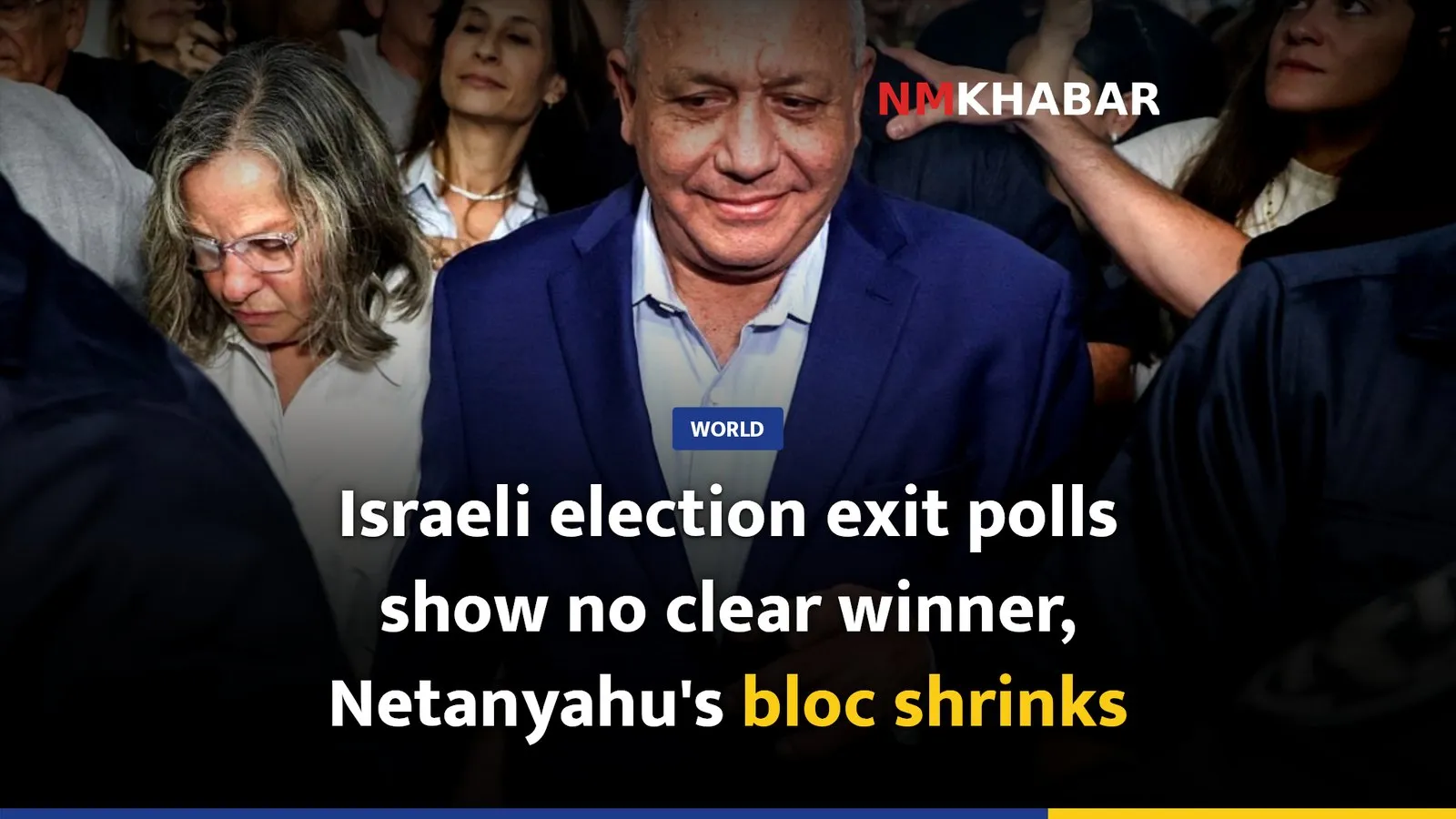
Exit polls from Israel’s election on October 27, 2026, indicate a political deadlock, with Prime Minister Benjamin Netanyahu’s coalition projected to lose a substantial number of seats. While his Likud party is expected to remain the largest, neither Netanyahu’s bloc nor his challenger Gadi Eisenkot’s bloc has secured the 61 seats needed for a majority in the 120-seat Knesset.The election, the first since the Hamas attacks of October 7, 2023, saw a record 77.7% voter turnout, the highest since 1999. Early unofficial results suggest Netanyahu’s bloc has fallen from 68 seats in the previous Knesset to around 50, according to Channels 11 and 12. Eisenkot’s Yashar party is projected to win 21 to 23 seats, with his overall bloc estimated at 52 to 53 seats.Yohanan Plesner, president of the Israel Democracy Institute, described the exit polls as a significant defeat for Netanyahu’s coalition. However, he cautioned that Eisenkot has not emerged as a clear winner either.The fragmented nature of the Israeli political system means that forming a coalition government will be challenging. Exit polls project Netanyahu’s Likud party to secure 24 to 25 seats, making it the largest single party. Eisenkot’s Yashar party is projected to win 21 to 23 seats.A notable development is the projected record win for Arab parties, estimated to secure 17 to 18 seats. This strength helped deny Netanyahu a majority, but Eisenkot’s previous commitments against relying on Arab parties complicate his path to forming a government. The Jerusalem Post noted that while a parliamentary majority against the outgoing government exists, there isn’t a clear agreement on what should replace it.Channel 14, a pro-Netanyahu outlet, presented an outlier projection, giving his coalition 60 seats and Eisenkot’s 43.Gadi Eisenkot, leader of the Yashar party, has claimed his bloc would get the first opportunity to form a government to replace Netanyahu. However, his campaign promises not to form a coalition with Arab parties present a significant hurdle to achieving a majority. Even with the support of Mansour Abbas’s Ra’am party, Eisenkot’s bloc would still fall short of 61 seats, and relying on the Joint List would introduce further political obstacles.The possibility of a minority government has emerged, which could win a confidence vote without 61 seats, though internal opposition within Eisenkot’s bloc to relying on Arab parties could complicate this. Another option for Eisenkot could be to include the two haredi (ultra-Orthodox) parties, projected to win 12 seats, which could provide a majority but would give them considerable leverage over policy commitments.A numerically straightforward but politically complex option would be a unity government comprising Likud, Yashar, Naftali Bennett’s B’Yachad, and Yisrael Beytenu, which together could command 67 seats. This would, however, require Netanyahu’s opponents to abandon their promises not to serve under him and agree on leadership terms.The Central Elections Committee is expected to announce the official results of the October 27, 2026 election by Wednesday evening. Final vote counts are anticipated by October 30, with official results published on November 4.After the official results are released, Israeli President Isaac Herzog will meet with each party in the new Knesset. He will then task the member of parliament most likely to form a government with the responsibility. Coalition talks could take weeks or even months. If no party can secure a majority, a minority government, a unity government, or even another election remains a possibility.
Background
- This was the first election in Israel since the Hamas attacks of October 7, 2023.
- In the 2022 election, Prime Minister Benjamin Netanyahu's coalition won 68 seats.
- In 2009, Tzipi Livni's Kadima party won one more seat than Likud, but Netanyahu became prime minister because he could assemble a coalition.