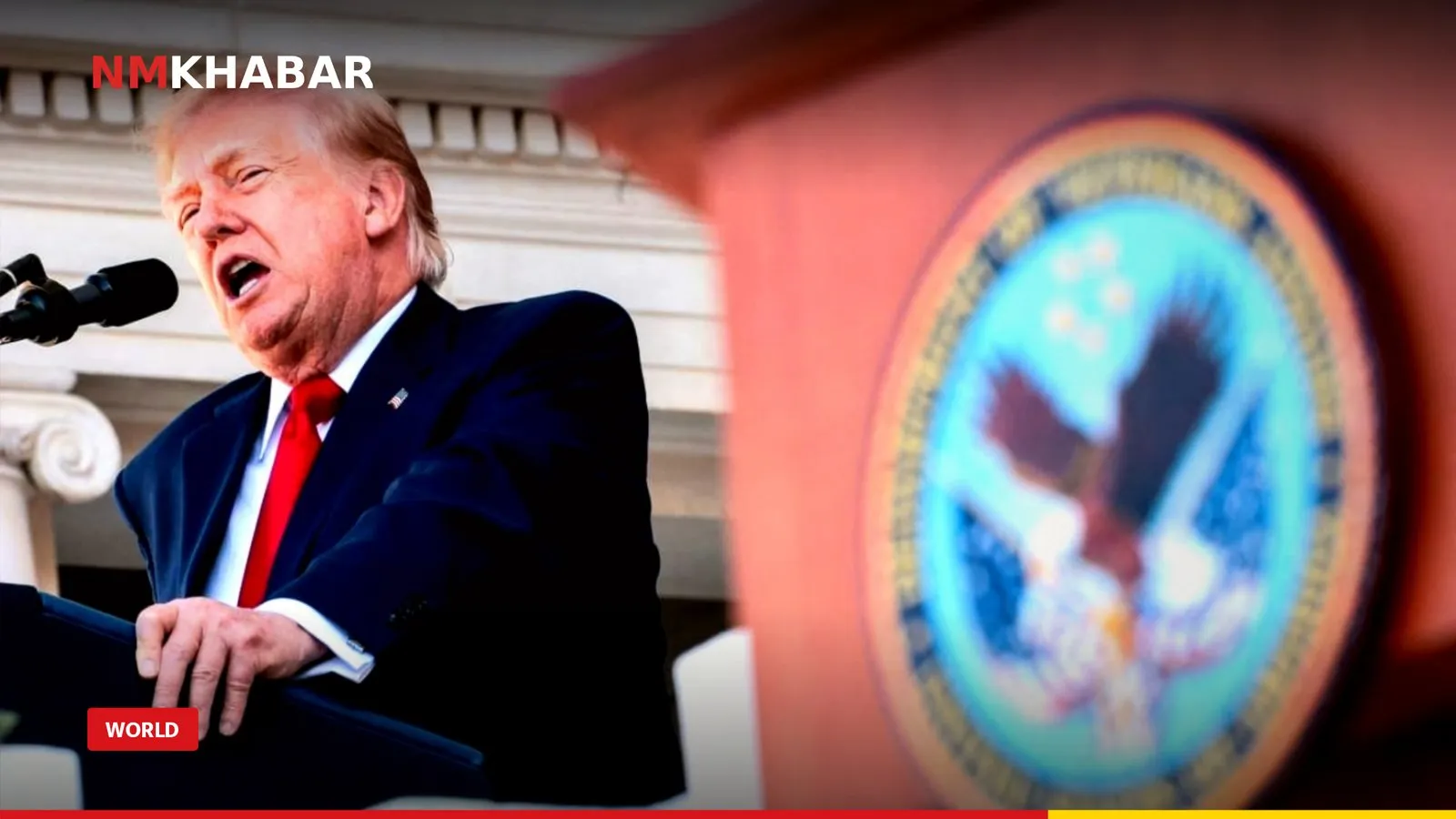
US President Donald Trump threatened Thursday to renew military strikes against Iran, stating he would act ‘without hesitation’ if Iran threatened US allies and American vessels. Speaking in an interview with the Salem News Channel, Trump claimed the US controls the Persian Gulf and the Strait of Hormuz, and that the blockade imposed on Iran has severely damaged its economy.Trump asserted that the Iranian regime is on the brink of collapse, with inflation reaching 301%, its economy destroyed, and its military forces wiped out. He also claimed the US has not lost a soldier in the last five months and that intensive fighting against Iran lasted only three weeks.Trump’s claims about Iran’s economic and military status, as well as US casualties, differ from international data. The International Monetary Fund (IMF) reported Iran’s inflation rate at 87.90% in July 2026, down from 88.60% in June 2026. The IMF’s October 2026 World Economic Outlook projected Iran’s real Gross Domestic Product (GDP) to contract by 7.6% in 2026.Regarding military strength, Iran ranked 16th out of 145 countries in the 2026 Global Firepower assessment. Its military inventory includes approximately 610,000 active personnel, 350,000 reservists, 551 aircraft, 2,675 tanks, over 75,000 armored vehicles, 1,550 rocket projectors, and 25 submarines.Contrary to Trump’s assertion of no US casualties in the past five months, the Pentagon reported on October 29, 2026, that 23 US service members had died in the Iran war. This includes two non-combat deaths added to the public database on that date. On October 13, 2026, the Pentagon had reported 21 service members killed and 865 wounded.In response to Trump’s threats, Iranian military officials warned of severe retaliation. Brigadier General Abolfazl Shekarchi, senior spokesperson for Iran’s armed forces, stated on November 12, 2026, that any US attack would be met with a tenfold more intense response. Keyoumars Heidari, Iran’s Deputy Armed Forces Chief, indicated that Iran has prepared an expanded list of potential targets beyond the Middle East. Mohammadreza Naghdi, an advisor to the Revolutionary Guards, said the armed forces have been authorized to retaliate without geographical restrictions.
Background
- Donald Trump began his second term as the 47th President of the United States on January 20, 2025.
- A joint US and Israeli military offensive against Iran, named 'Operation Epic Fury' by the US, began on February 28, 2026, resulting in the deaths of Iran's Supreme Leader Ali Khamenei and dozens of other top officials.
- The US imposed a naval blockade on Iran on April 13, 2026, which was resumed after a brief attempt at a memorandum of understanding to end hostilities on June 14, 2026, intensifying Iran's economic crisis.
What happens next
Iranian military officials have threatened to target US bases in Europe and other global targets if the US launches new attacks against Iran. Talks between the US and Iran have stalled due to disagreements on key issues such as reopening the Strait of Hormuz and Iran's nuclear capabilities.
Why it matters for Nepal
According to Nepal's Ministry of Foreign Affairs, 10 Nepali citizens are legally residing in Iran, with four in the process of returning and six remaining there. Data from Nepal's Department of Foreign Employment shows a 52.12% decrease in new work permits for Gulf countries since the start of the Iran war (February 28, 2026, to mid-September 2026).