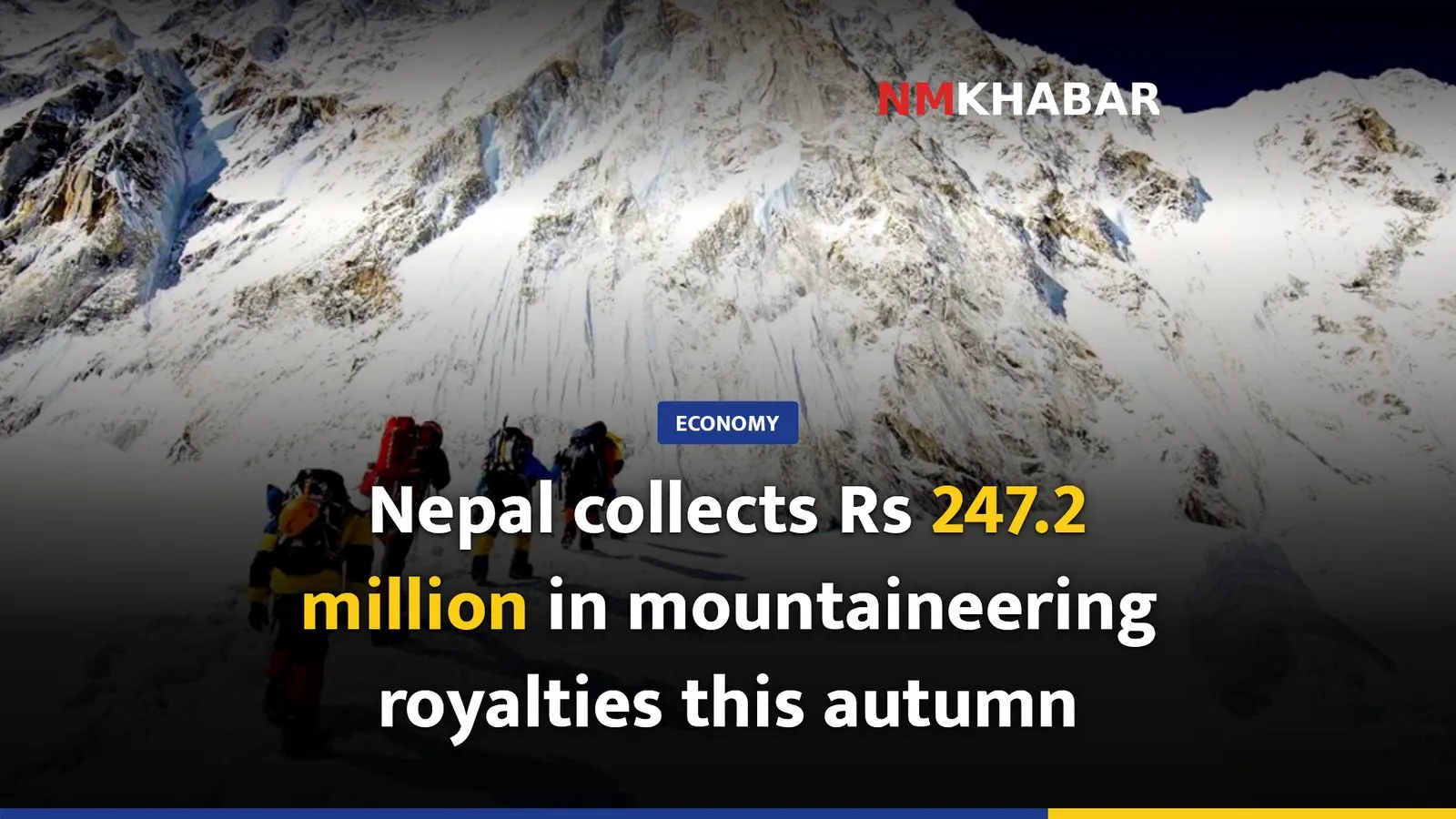
Nepal’s Department of Tourism collected Rs 247.2 million (USD 1.62 million) in royalties from 788 mountaineers who obtained permits to climb 31 different peaks during the autumn season of 2026. A total of 91 teams were granted permission for these expeditions, according to Suraj Ghimire, Information Officer at the Department of Tourism.
Of the 788 climbers, 582 are men and 206 are women. These mountaineers represent 70 different countries, with China having the largest contingent of 118 climbers. Other significant numbers include 65 from Russia, 60 from France, 52 from the United States, 45 from the United Kingdom, 25 from Poland, 23 from Nepal, 18 from India, 23 from Italy, and 25 from Japan.
Mount Manaslu, standing at 8,163 meters, proved to be the most popular peak this autumn, attracting 500 climbers across 43 teams. The Department of Tourism collected Rs 225.8 million in royalties from Manaslu expeditions alone. Dhaulagiri-I saw 36 climbers in five teams, generating Rs 8.2 million in royalties. Himlung Himal attracted 34 climbers in three teams, contributing Rs 2.08 million, while Ama Dablam drew 19 climbers in two teams, yielding Rs 2.9 million.
Other peaks for which permits were issued include Putha Hiunchuli, Danga Hiunchuli, Baruntse Himal, Makalu, Gangapurna West (Langchenel), Thorong Peak, Norbu Khang, Annapurna-IV, Chamlang, Lamjung Himal, Pumori, Saribung, Thapa Peak (Dhampus), Pokhar Khang, Ardang, and Peril.
Background on mountaineering in Nepal
Nepal’s mountaineering history dates back to the 1950s, with the first ascent of an 8,000-meter peak, Annapurna, by French climbers Maurice Herzog and Louis Lachenal in 1950. The country gained global recognition as the ‘Land of the Himalayas’ after Tenzing Norgay Sherpa and Edmund Hillary successfully summited Mount Everest in 1953.
The government issues climbing permits under the Mountaineering Regulations 2059 (BS). New fees for climbing came into effect on September 1, 2025 (Bhadra 16, 2082 BS), after a decade. For foreign nationals, Everest climbing now costs USD 15,000 in spring, USD 7,500 in autumn, and USD 3,750 in winter and monsoon seasons. For other peaks above 8,000 meters, the fees are USD 3,000 in spring, USD 1,500 in autumn, and USD 750 in other seasons.
Nepal boasts 1,310 peaks above 6,000 meters, with the government having opened 461 for climbing. The government has also announced a two-year fee waiver for climbing 97 peaks in Karnali and Sudurpashchim provinces, aiming to boost tourism in these regions.
Tourism initiatives and future outlook
The Nepal government has declared 2025 as ‘Nepal Visit Year’ and aims to attract 3.5 million tourists annually by celebrating 2022-2032 as the ‘Tourism Decade’.
Earlier, on Ashoj 13 (BS), the Department of Tourism had reported that 637 climbers in 68 teams had received permits for 18 peaks, generating Rs 238.5 million in royalties for the autumn season of 2026.
The full list of all 31 peaks for which permits were issued this autumn is not yet available. It is also unclear which specific peaks the 23 Nepali climbers obtained permits for, or how many permits were issued for Mount Everest during this autumn season.