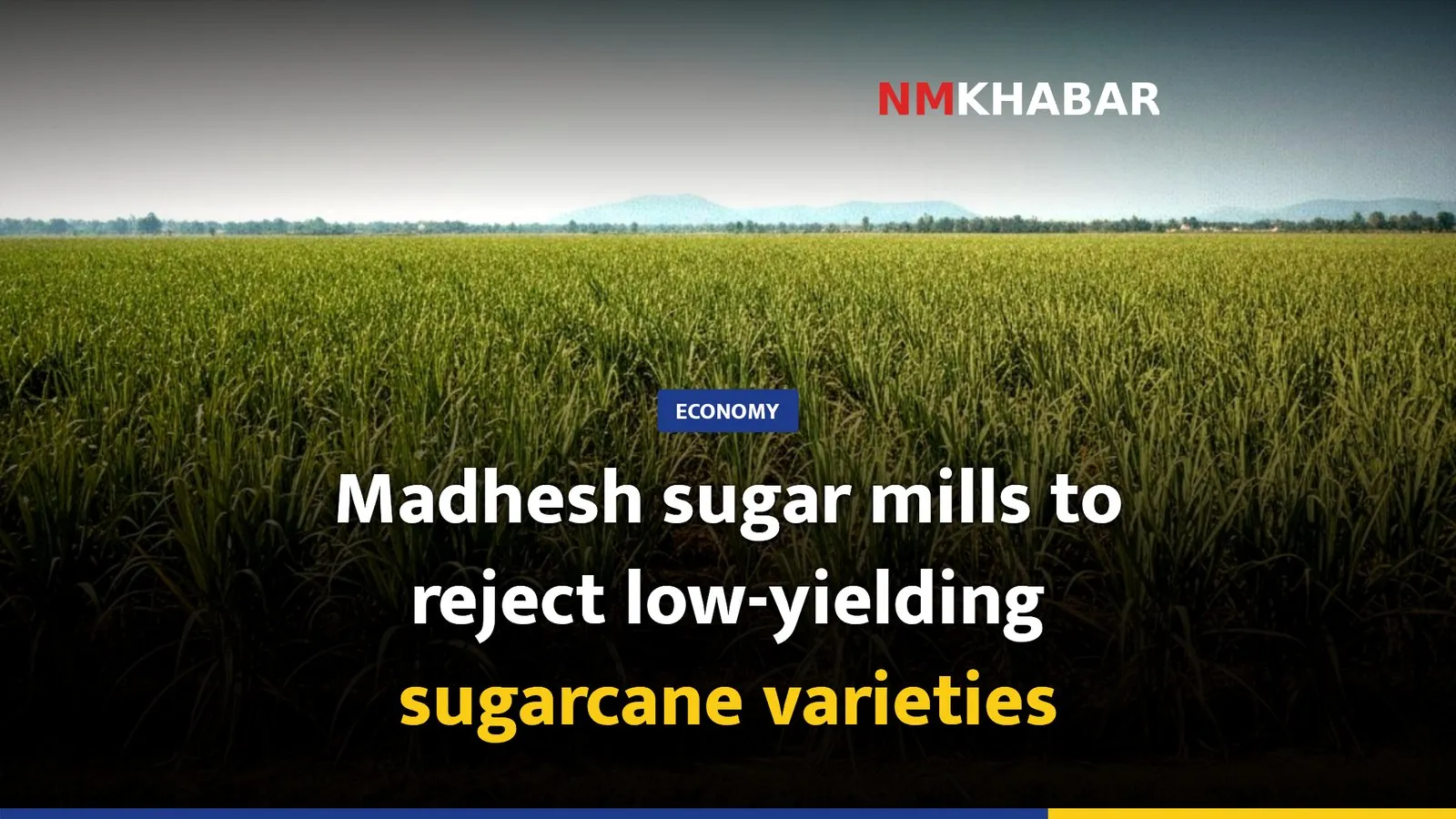
Sugar mills in Madhesh Province have announced they will no longer purchase low-yielding sugarcane varieties this year, a collective decision aimed at compelling farmers to cultivate more productive and high-sugar content crops. This move directly impacts farmers who have traditionally grown older, less efficient sugarcane varieties.
The mills have explicitly indicated that they will either refuse to buy such sugarcane or farmers will need to find alternative arrangements for their produce. This decision stems from long-standing issues in sugarcane production, including pest and disease outbreaks, low yields, low sugar content in the cane, and poor sugar recovery during processing, according to Baiju Babara, operator of Baba Baijunath Sugar Mill.
Reasons for the Decision
For the past four years, sugar mills have been urging farmers to gradually discontinue the cultivation of varieties such as CoSe-91269, CoSe-9206, Co-0233, Bo-160, CoS-95422, BO-147, CoP-2061, Co-0235, CoS-8436, BO-91, BO-110, CoSe-88216, Co-86032, CoSe-92270, CoSe-92423, BO-139, BO-141, BO-120, CoSe-07250, CoP-9302, BO-150, CoH-152, and CoIk-8102. These varieties have failed to deliver expected yields and sugar recovery rates.
Yog Narayan Rajak, Sugarcane General Manager at Indu Shankar Sugar Industry, stated that low-quality sugarcane results in reduced field production and lower sugar recovery during processing, leading to financial losses for both farmers and industries. Sugar mill operators emphasize that simply increasing sugarcane production is not enough; the sugar content and recovery rate are equally crucial. They argue that even with good field yields, low sugar content varieties increase processing costs for mills and prevent farmers from earning expected incomes, thus urging a shift away from old varieties.
Yog Narayan Rajak, Sugarcane General Manager at Indu Shankar Sugar Industry, also advised farmers to use pest and disease management methods like Trichoderma, TPM, and Coragen for cultivation.
Path Forward for Farmers
In their joint notice, the sugar mills have recommended cultivating varieties that mature quickly, offer higher yields, and have greater sugar content. These include Co-0118, CoIk-94184, Co-15023, CoIk-14201, CoIk-16202, CoS-17231, CoS-18231, CoP-9301, Co-98014, UP-5125, CoIk-15206, CoIk-15466, Co-05011, CoS-08279, CoS-08272, and CoS-13235. Farmers are encouraged to contact their respective sugar mills for seeds and management of these recommended varieties.
However, sugarcane farmers in Madhesh Province demand that before implementing the mills’ decision, adequate and quality seeds of the recommended varieties must be made available. They also call for facilitation in replacing old varieties and a clear policy on purchase prices and sugar recovery rates. Given that changing sugarcane varieties cannot be achieved in a single year, a phased approach to replacing low-quality varieties is necessary, requiring coordination among industries, farmers, agricultural technicians, and the government.
Madhesh’s Role and Broader Context
Madhesh Province is a fertile agricultural region, leading in the production of rice, vegetables, fruits, and sugarcane, supplying a significant portion of Kathmandu Valley’s demand. Eight sugar mills are currently operational for sugarcane crushing in Madhesh Province.
Commercial sugarcane farming in Nepal began with the establishment of Morang Sugar Mill Limited in Biratnagar in 2005 BS. After government-owned sugar mills like Birgunj Sugar Factory closed around 2058 BS, the private sector’s monopoly grew, leading to various irregularities. Over the past 30 years, 21 of the 31 sugar industries that operated in Nepal have shut down, indicating instability in the sector.
Nepal Rastra Bank, the central bank, reported a 16.82 percent decline in sugarcane production in Madhesh Province by mid-January of the fiscal year 2081/82. Madhesh Province contributes 65 percent of Nepal’s total sugarcane production, according to data from January 5, 2023. In fiscal year 2078/79 (2021/22), Nepal cultivated sugarcane on 62,500 hectares, producing 3.159 million metric tons.
Government Subsidies and Unresolved Issues
The federal government had set a minimum purchase price of Rs 635 per quintal for sugarcane, with sugar mills paying Rs 565 and the government providing a subsidy of Rs 70 (as of November 2023). However, in the budget for fiscal year 2082/83 (2025/26), the government subsidy was reduced from Rs 70 to Rs 35 per quintal. The Madhesh Province government, on the other hand, agreed to provide an additional subsidy of Rs 10 per quintal to farmers (as of November 2023).
There is a significant risk that farmers will be directly affected if mills refuse to buy low-quality varieties without adequate alternatives and seeds. Sugarcane cultivation contributes approximately Rs 18 billion to Nepal’s economy, but domestic production meets only about 55 percent of the total sugar demand. Nepal consumes an estimated 250,000 metric tons of sugar annually.
The Madhesh Province government is preparing to continue its sugarcane farmer subsidy and formally request the federal government to do the same, as of November 26, 2025. However, despite Federal Finance Minister Bishnu Prasad Paudel stating in June 2026 that a budget was allocated for sugarcane farmers, Kapilmuni Mainali, chairman of the Nepal Sugarcane Producers Federation, complained in October 2026 that farmers had not yet received the subsidy, alleging injustice by the government. This indicates a lack of clarity regarding the status and reasons for the subsidy distribution.
In November 2023, then Minister of Industry, Commerce and Supplies Damodar Bhandari proposed forming a special task force with stakeholders to resolve the long-term problems of sugarcane farmers and sugar industries, instructing it to find solutions within 15 days. However, the report and implementation status of this task force have not yet been made public, leaving the future resolution of sugarcane farmers’ issues uncertain.