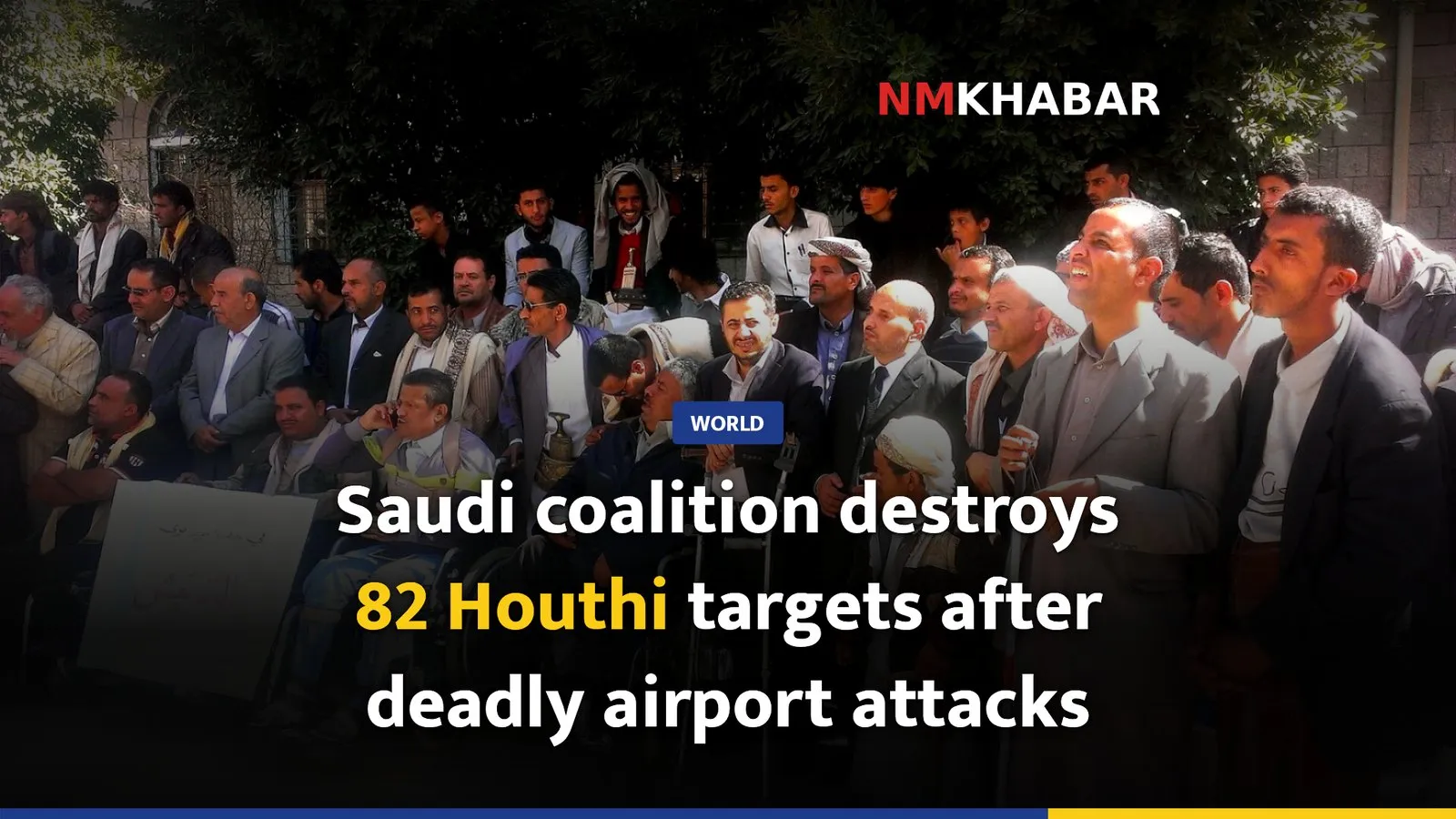
The Saudi-led coalition fighting Yemen’s Houthi militia has destroyed 82 military targets across Yemen in response to recent deadly attacks on civilian infrastructure in Saudi Arabia, including airports in Riyadh and Abha. The coalition announced the comprehensive operation after three people were killed and 36 injured in the Houthi attacks.
Maj. Gen. Turki Al-Malki, spokesman for the Saudi-led coalition, stated that the attacks on civilians and civilian objects “will not go unpunished,” according to a statement carried by the Saudi Press Agency (SPA). The Joint Forces of the Coalition carried out a “comprehensive operation” targeting Houthi military positions in the Yemeni governorates of Saada, Al-Hudaydah, Al-Jawf, and Marib.
Details of the Coalition’s Operation
The destroyed targets included 11 mountain-based ballistic missile storage facilities in Saada, as well as command and control centers, communications systems, missile and weapons depots, and gathering sites used by Houthi forces. The operation followed attacks on King Khalid International Airport in Riyadh and Abha International Airport in the southwestern Asir region.
In the airport attacks, three people were killed and 36 injured, according to Saudi civil aviation authorities. Two women, a Moroccan and an Algerian, died in the attack on Abha airport, where 28 people were injured. A Sudanese man was killed and eight people were injured in the attack on King Khalid airport in Riyadh.
The coalition also reported intercepting and destroying a ballistic missile launched toward Riyadh on Wednesday. The launch platform used in that attack was subsequently destroyed in Sanaa while militants were preparing it for an imminent attack against Saudi Arabia.
Escalation of a Protracted Conflict
These latest strikes mark a sharp escalation in the conflict, which has intensified after years of relative calm. A UN-backed truce that began in April 2022 had brought a prolonged period of relative calm, but recent territorial advances and fighting have revived the war on a major scale.
Saudi Arabia and allied Yemeni government forces have launched a major ground and air offensive to retake territory seized by the Houthis along Yemen’s western Red Sea coast and near the Bab Al-Mandab Strait. The fighting has centered in areas including Dhubab and around the strategic port of Mokha. The Houthis have sought to maintain positions overlooking the Bab Al-Mandab, a critical maritime chokepoint through which about 12 percent of global trade passes.
The Institute for the Study of War has indicated that the Houthis appear to view attacks on civilian infrastructure, including airports and oil facilities, as a means of increasing Saudi Arabia’s economic costs and pressuring Riyadh to meet their demands. The escalation has also raised concerns about threats to vital energy and shipping infrastructure.
Humanitarian Impact and Nepali Workers
The renewed fighting has taken a heavy humanitarian toll. The Associated Press (AP) reported that nearly 1,000 people have been killed and more than 200,000 displaced in the latest escalation, while the World Health Organization (WHO) has warned of rising cholera and malnutrition cases and shortages of medical supplies at some hospitals.
For Nepali workers in Saudi Arabia, the conflict adds another layer of concern to existing challenges. Problems faced by Nepali migrant workers extend beyond employment, wages, and workplace conditions to include death, repatriation of bodies, post-accident compensation, blood money, imprisonment, legal processes, exit permits, and issues related to labor approvals and documentation.
According to the latest data released by the Nepali Embassy in Riyadh, 154 Nepalis died in Saudi Arabia between July 18, 2025, and July 16, 2026. Of these, 99 deaths were natural, 29 were suicides, 19 were due to vehicle accidents, and seven were workplace accidents. As of September 20, 2026, 419 Nepalis were held in Saudi prisons, with alcohol-related offenses being a primary cause. The Nepali Embassy regularly handles the necessary procedures for repatriating the bodies of workers who die abroad.
Naresh Sapkota told Naveen Sanchar Online on January 27, 2026, that the situation for Nepalis in Saudi Arabia is dire. The number of death penalty executions in Saudi Arabia has been increasing annually, with 1,800 individuals executed in the last decade. In the past three years alone, three Nepalis have been executed.
Coalition Pledges Continued Support
The coalition has pledged continued operational support for Yemen’s internationally recognized government as it seeks to reverse Houthi territorial gains. Maj. Gen. Al-Malki stated in an October 4 statement that coalition forces would continue supporting Yemeni government forces and described the Houthi threat to shipping in the southern Red Sea and Bab Al-Mandab as a threat to regional and international security.
Our earlier story reported that Saudi air defenses intercepted a Houthi ballistic missile north of Riyadh, and the Nepali Embassy in Saudi Arabia had urged Nepalis there to remain vigilant.